


Before the Transfiguration, Jesus is speaking with His disciples in Luke 9 (with the Transfiguration itself recorded in Matthew 17). These two passages fit together.
Jesus begins by asking His disciples, “Who do people say I am?” They answer, “Some say John the Baptist. Others say Elijah or one of the prophets.”
Then Jesus asks the most important question: “But who do you say I am?”
Peter answers correctly: “You are the Christ, the Son of the living God.” He understands who Jesus is—but he still doesn’t understand why Jesus came.
When Jesus explains that He must suffer, be rejected, and be killed, Peter cannot accept it. He insists that this must never happen. Jesus replies, “Get behind me, Satan!”
That response can sound shocking, but Jesus is making an important point. Anything that tries to stop Him going to the cross is working against God’s plan. Satan’s goal has always been to prevent people from receiving life. But Jesus knows that eternal life will only come through His suffering, death, and resurrection.
Jesus then tells His disciples not to tell anyone that He is the Messiah. It simply isn’t the right time yet. If people believed He was the Messiah too soon, they would try to make Him the kind of king they wanted—a political ruler who would overthrow Rome—instead of understanding that He came first as the suffering Servant.
This must have been incredibly confusing for the disciples. When they read the Old Testament, they expected a victorious King who would establish an everlasting kingdom. They were thinking of someone like David, only greater.
They were not expecting the Messiah to suffer and die.
Yet Jesus tells them plainly: “The Son of Man must suffer many things, be rejected by the elders, chief priests and teachers of the law, be killed, and on the third day be raised to life.”
Looking back now, we can see this was always God’s plan.
Passages such as Psalm 22 and Isaiah 53 clearly describe a Messiah who would suffer, be rejected, and even be betrayed by those closest to Him.
But before the resurrection, the disciples struggled to understand it.
Then Jesus says something even more challenging. Not only must He suffer—His followers must be willing to suffer too.
He says: “If anyone would come after Me, let him deny himself, take up his cross daily, and follow Me.”
Today we often think “taking up your cross” simply means dealing with life’s difficulties. But that is not what Jesus’ first listeners would have heard.
In the Roman world, crosses were everywhere. They lined the roads as a warning.
Victims were beaten, whipped, and nailed to crosses where everyone could see them. The message was clear: “Do not rebel against Rome, or this will happen to you.”
So when Jesus says, “Take up your cross daily,” He is calling His followers to complete surrender. Be willing to give up everything—even your life—for Him.
Put His mission above your own desires, even if it means rejection, suffering, or death.
This is not an easy invitation. Jesus never promised a comfortable life.
He continues: “Whoever wants to save his life will lose it, but whoever loses his life for My sake will save it.”
In other words, if we spend our lives chasing comfort, success, and our own plans while rejecting Christ, we may gain everything this world offers but lose what matters most—our souls.
Jesus asks: “What does it profit someone to gain the whole world, yet lose or forfeit themselves?”
Then He warns that anyone ashamed of Him now will find that He is ashamed of them when He returns in glory.
Finally, Jesus says: “Some who are standing here will not taste death before they see the kingdom of God.”
Only a few days later, Peter, James, and John witness the Transfiguration. They see a glimpse of Christ’s glory and the coming Kingdom. But Jesus wants them to understand something first:
Glory comes after suffering.
This is a pattern woven throughout Scripture—and even into everyday life.
If we always choose comfort now, pain often follows later. Ignore your health today, and your body will eventually suffer. Spend every penny now, and financial hardship will come later. Refuse to study today, and opportunities tomorrow may be limited.
But if you are willing to sacrifice now, the rewards often come later. Exercise brings health. Saving brings security. Studying opens doors. Hard work today produces fruit tomorrow.
The Christian life follows the same pattern. Jesus promises glory—but not before the cross. He calls His followers to deny themselves, take up their cross, and follow Him.
That means trusting Him even when life is difficult, standing for Him even when it costs us, and remaining faithful through suffering.
This is something the modern church can sometimes overlook. We often emphasise that believing in Jesus brings forgiveness and eternal life—and that is gloriously true. But Jesus also calls every believer to follow Him through hardship.
If we are not prepared for suffering, our faith can be shaken when trials come.
But when we understand that suffering has always been part of following Christ, we are not surprised by it. Instead, we endure with hope, knowing that just as Jesus’ suffering led to glory, ours will too.
Jesus is not giving His disciples a false sales pitch. He is completely honest. He tells them, “This world is fallen. You will face trials. You will suffer. But take heart—I have overcome the world.”
This world is not our home. It is broken by sin. That is why we experience pain, sickness, injustice, and death. None of these things were part of God’s original creation, and one day Christ will make all things new.
But until then, our calling is clear. We are not to live only for this world. We are to deny ourselves, point people to Christ, and invite them into the Kingdom of God.
Ironically, that kind of life doesn’t make this life smaller—it makes it richer. Living for Christ gives life meaning now, and it leads to an eternal glory that far outweighs any suffering we experience.
The disciples, however, are struggling to understand. Peter has just said, “I will never let You suffer.” Now Jesus tells him that not only must He suffer, but His followers must be willing to suffer too.
Imagine what must have been going through their minds. “What do you mean? I thought You were the Messiah. I thought You were going to establish Your Kingdom now!”
Even right up to the crucifixion, the disciples are still arguing about who is the greatest and who will sit at Jesus’ right and left hand. They are expecting glory immediately.
But Jesus keeps telling them the same truth: Suffering comes first. Glory comes afterwards.
After giving them this difficult teaching, Jesus does something remarkable. He gives three of His disciples a glimpse of the glory that lies beyond the suffering.
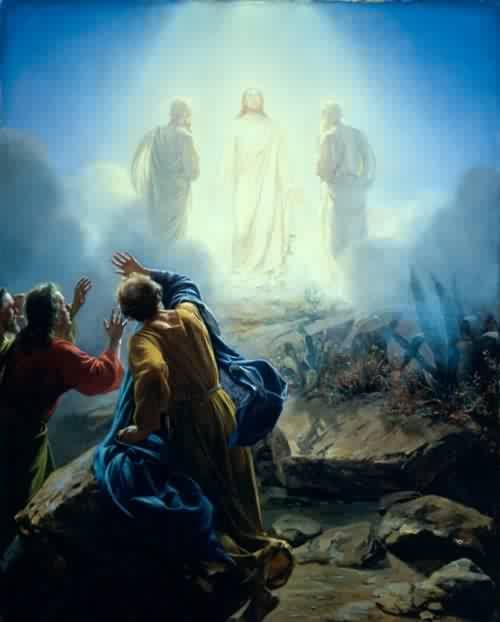
About eight days later, Jesus takes Peter, James, and John up a high mountain to pray.
The Bible doesn’t name the mountain. Some believe it was Mount Tabor, but many think it was Mount Hermon in the north of Israel.
Mount Hermon is the highest mountain in the region, and its melting snow feeds the Jordan River. Interestingly, the name Hermon can mean “holy mountain,” making it a fitting location for what is about to happen.
As Jesus prays, everything changes. Luke writes: “The appearance of His face was altered.” Matthew describes it even more vividly:
“His face shone like the sun, and His clothes became as white as the light.”
The word translated “transfigured” comes from the Greek word metamorphoō, from which we get our English word metamorphosis. Jesus is not becoming someone else—His true glory is being revealed.
This is especially significant because Isaiah 53 tells us that when the Messiah came to earth, He would have “no beauty or majesty to attract us to Him.” Jesus did not come in earthly splendour or outward magnificence. He came humbly as a servant.
But on the mountain, for a brief moment, the veil is pulled back. The disciples see Jesus as He truly is. His divine glory shines through. Then two unexpected figures appear beside Him: Moses and Elijah. Luke tells us they appeared in glory and were speaking with Jesus about “His departure.”
The Greek word Luke uses is exodos—the same word from which we get Exodus.
That is no coincidence. Moses led Israel out of slavery in Egypt and through the Red Sea into freedom. Jesus is about to accomplish a far greater Exodus.
Through His death, resurrection, and ascension, He will lead people out of slavery to sin and death and into eternal life.
Moses delivered God’s people from physical bondage. Jesus delivers all who trust in Him from spiritual bondage.
How fitting that Jesus is discussing His coming “Exodus” with Moses himself.
Elijah’s presence is just as significant. Both Moses and Elijah encountered God on Mount Sinai. Moses received the Law there.
Elijah fled there after defeating the prophets of Baal. Discouraged and exhausted, he met God—not in the wind, the earthquake, or the fire—but in a gentle whisper while sheltered in the cleft of the rock. Now these two great prophets stand with Jesus on another holy mountain, speaking about the greatest act of salvation the world will ever know.
Meanwhile, Peter, James, and John are struggling to stay awake. Luke says they were “heavy with sleep.”
Considering everything they had experienced, that is hardly surprising. They had spent months travelling with Jesus, walking from town to town, surrounded by crowds, witnessing miracles, and living under constant tension as the religious leaders plotted against Him.
They were physically and emotionally exhausted. But suddenly they wake fully.
Before them stands Jesus, His face shining like the sun, His clothes dazzling white, with Moses and Elijah beside Him.
Imagine opening your eyes to that. It must have taken their breath away.
As Moses and Elijah begin to leave, Peter blurts out the first thing that comes into his head. As usual, Peter speaks before he thinks.
Yet even in his impulsive words, we learn something important about what he believed was happening. Peter is overwhelmed by what he sees. He says, “Master, it is good for us to be here. Let us make three shelters—one for You, one for Moses, and one for Elijah.”
The word translated “shelters” can also mean tabernacles.
Why would Peter suggest building tabernacles?
Throughout the Old Testament, the Tabernacle was the place where God’s presence dwelt among His people. It was not something built to honour ordinary men. It belonged to God alone.
Yet Peter sees Jesus, Moses, and Elijah standing together in glory and blurts out the first thing that comes into his mind. He wants to build a tabernacle for each of them.
Luke quickly adds that Peter “did not know what he was saying.” Peter’s suggestion was mistaken because Moses and Elijah were servants of God, not objects of worship. Only God deserves a temple.
Even so, Peter’s reaction reveals just how astonishing this moment was. Moses and Elijah appeared so radiant with God’s glory that Peter instinctively wanted to honour them in the highest way he knew. There is also a wonderful glimpse here of our own future.
The Bible teaches that one day believers will share in Christ’s glory.
We will not become gods, nor will we ever equal Christ, but we will be completely transformed into His likeness.
Paul writes that our bodies will be transformed to be like Christ’s glorious body, and John says: “When He appears, we shall be like Him, for we shall see Him as He is.” It is difficult to imagine what that will be like. Every trace of sin, shame, jealousy, and selfishness will be gone. We will reflect the glory of God in a way we cannot even comprehend today.
God is preparing His people to be the Bride of Christ. That is an astonishing thought. Christ is infinitely glorious, yet He is making His Church beautiful and holy so that she may be presented to Him without stain or blemish. We cannot fully grasp what that future will look like, but Scripture promises it will be beyond anything we can imagine.
Before Peter can say anything else, everything changes.
A cloud comes down and overshadows them.
This is no ordinary cloud.
Throughout the Old Testament, the cloud was the visible sign of God’s presence. It covered Mount Sinai when Moses met with God. It filled the Tabernacle and later the Temple, showing that God’s glory had come to dwell among His people.
Now that same glorious cloud surrounds Jesus and His disciples. Then a voice speaks from the cloud: “This is My Son, My Chosen One; listen to Him.” These few words are packed with meaning. God is bringing together three of the greatest promises in the Old Testament and declaring that they are all fulfilled in Jesus.
“This is My Son.” This points to Psalm 2, where God’s promised King is called His Son—the Messiah who will rule the nations.
“My Chosen One.” This echoes Isaiah 42, where God speaks of His chosen Servant, the One who will bring justice to the nations through humble obedience.
“Listen to Him.” These words take us back to Deuteronomy 18, where Moses promised that one day God would raise up a Prophet like him, and Israel must listen to Him.
God is declaring that Jesus is all three.
He is the promised King. He is the suffering, Servant. He is the greater Prophet. The Law pointed to Him. The Prophets pointed to Him. The Psalms pointed to Him.
Everything in the Old Testament finds its fulfilment in Jesus Christ.
Notice something else. Peter wanted to place Jesus alongside Moses and Elijah. The Father corrects him. Jesus is not one of three great men. He stands above them all.
Moses was the great lawgiver, but Jesus fulfils the Law.
Elijah was one of Israel’s greatest prophets, but Jesus is the One to whom every prophet pointed.
They were faithful servants. He is the eternal Son of God.
Matthew tells us that when the disciples heard the Father’s voice,
“They fell face down to the ground, terrified.”
Just as Israel trembled at Mount Sinai, the disciples now find themselves in the very presence of the glory of God.
The difference is that this time, standing before them is not only the God who speaks from heaven, but the Son who has come to bring them safely into His presence.
The disciples have just witnessed something beyond words.
They have seen Jesus’ face shine like the sun. They have seen Moses and Elijah appear in glory. They have heard the voice of the Father speak from heaven.
Yet when God’s voice is heard, they do not stand in confidence.
They fall on their faces in terror.
This is exactly what happened at Mount Sinai. Whenever sinful people come face to face with the holiness of God, fear is the natural response.
But then something wonderful happens.
Matthew tells us: “Jesus came and touched them. ‘Rise,’ He said. ‘Do not be afraid.’ “That small detail is easy to miss, but it is beautiful.
The holiness of God causes them to fall down. The touch of Jesus lifts them back up.
He is the One who makes it possible for sinful people to stand in the presence of a holy God.
This moment never left Peter. Years later, when people questioned why he was willing to risk everything for Jesus, Peter pointed back to this very event.
He writes: “We did not follow cleverly devised myths… but we were eyewitnesses of His majesty… We ourselves heard this voice that came from heaven when we were with Him on the holy mountain.” (2 Peter 1:16–18)
Peter’s faith was not built on rumours or legends. He had seen Jesus’ glory with his own eyes. He knew who Jesus truly was. That is why he was willing to suffer for Him.
After the voice from heaven, Moses and Elijah disappear. Only Jesus remains. The disciples are told to keep what they have seen a secret until after the resurrection.
Why? Because they first needed to understand that glory comes through the cross.
If they had rushed out proclaiming Jesus’ glory without His suffering, people would have wanted the crown without the cross. They would have welcomed Him as a conquering King but rejected Him as the suffering Saviour.
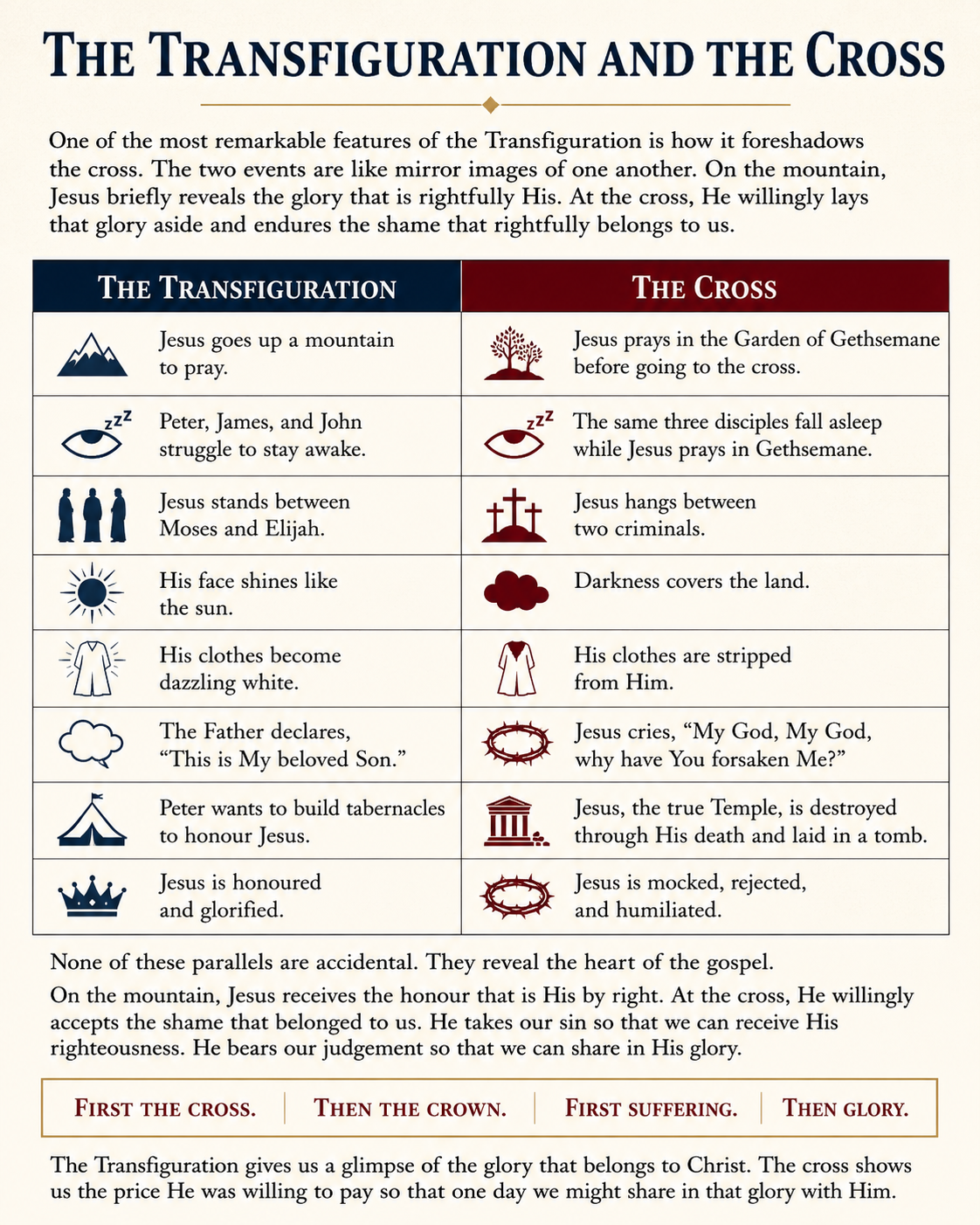
Only after the resurrection would the full picture make sense. The path to glory was always through suffering. The Transfiguration and the Cross One of the most remarkable things about the Transfiguration is that it is almost a mirror image of the crucifixion.
Everything Jesus receives on the mountain is reversed at the cross.
- The Transfiguration shows us the glory that rightly belongs to Jesus.
- The cross shows us what He willingly accepted instead.
- On the mountain, He receives honour.
- On the cross, He bears shame.
- On the mountain, He shines with glory.
- On the cross, He is covered in darkness.
- On the mountain, the Father publicly delights in Him.
- On the cross, He endures the judgement our sins deserved.
That is the heart of the gospel.
Jesus takes what belongs to us so that we may receive what belongs to Him.
He bears our sin so that we may share in His righteousness.
He accepts our shame so that we may share in His glory.
He dies the death we deserved so that we may receive the life He deserves.
That is the great exchange.
The Transfiguration gives us a glimpse of Christ’s glory. The cross shows us the price He was willing to pay to share that glory with us.
John, who witnessed the Transfiguration, later receives another vision in the book of Revelation. This time, the glory is no longer seen only in Christ. It is shared with His people. John writes:
“The marriage of the Lamb has come, and His Bride has made herself ready. Fine linen, bright and pure, was given her to wear.”
The dazzling white clothing that once belonged only to Christ is now given to His Bride.
Then an angel says, “Come, I will show you the Bride, the wife of the Lamb.”
John is carried to a great and high mountain, echoing the language of the Transfiguration. There he sees the New Jerusalem coming down from heaven, “having the glory of God.” The glory that shone from Christ on the mountain now fills His redeemed people.
Even John’s response echoes the Transfiguration. When he falls down in fear before the glorious Christ, Jesus reaches out and touches him, saying,
“Do not be afraid.” The same Jesus who touched the frightened disciples on the mountain now comforts John with those very same words.
The Transfiguration was never just about revealing who Jesus is. It was a preview of what Jesus is making His people into.
Because He endured the cross, those who trust in Him will one day be clothed in radiant glory, perfectly pure, and will dwell forever in the presence of God without fear.
The Transfiguration is not only a revelation of who Jesus is—it is also a glimpse of what He is preparing His people to become.
On the mountain, it is Jesus whose face shines like the sun. It is Jesus whose clothes become dazzling white.
But when John receives his vision in Revelation, something extraordinary happens.
Now it is the Church—the Bride of Christ—that is clothed in radiant white and shines with the glory of God. The glory that belonged to Christ is shared with His people.
That is our hope.
We often spend so much time focusing on the brokenness of this world. We see suffering, injustice, sickness, disappointment, and death. Scripture does not deny any of that. In fact, Jesus promises that we will face trials.
But the Bible never leaves us there. It constantly lifts our eyes to what is coming.
Paul writes: “God chose you… He called you through our gospel, that you might share in the glory of our Lord Jesus Christ.” (2 Thessalonians 2:13–14)
Think about that. God’s purpose is not simply to rescue us from judgement. His purpose is to bring us into the glory of His Son. As Christians, we rightly say, “To God alone be the glory.” Our lives should point people to Him.
Yet God’s response to those who trust Him is astonishing. He delights to share His glory with His redeemed people—not because we deserve it, but because of His grace.
Paul says that Christ “will transform our lowly bodies so that they will be like His glorious body.” (Philippians 3:21)
Have you ever stopped to think about what that means?
- No more weakness.
- No more sickness.
- No more fear.
- No more shame.
- No more sinful desires pulling us away from God.
Peter writes that believers will be “partakers of the glory that is going to be revealed” (1 Peter 5:1), and even says that we become “partakers of the divine nature” (2 Peter 1:4). He is not saying that we become gods. Rather, through Christ we are completely freed from sin and brought into perfect fellowship with God, reflecting His holy character forever.
John says something equally breathtaking: “Beloved, we are God’s children now, and what we will be has not yet appeared; but we know that when He appears we shall be like Him, because we shall see Him as He is.” (1 John 3:2)
John had already seen a glimpse of Christ’s glory on the Mount of Transfiguration.
Now he tells us that one day, when we finally see Christ face to face, we will be transformed into His likeness. We become like what we love. We become like what we worship. The more our eyes are fixed on Christ, the more His character is formed in us.
That transformation has already begun.
Paul writes: “We all, with unveiled face, beholding the glory of the Lord, are being transformed into the same image from one degree of glory to another.” (2 Corinthians 3:18)
Notice that this is happening now. As we spend time with Christ, trust Him, and grow in Him, the Holy Spirit changes us. Little by little, One degree of glory to another.
The Christian life is not simply about following rules. It is about becoming more like Jesus. And this transformation does not end when we die.
The Bible does not describe eternity as a static existence where nothing ever changes. Instead, we will spend eternity delighting more deeply in the infinite goodness, love, wisdom, and beauty of God. Because God is infinite, we will never reach the end of His greatness. Our joy in Him will never become exhausted.
Every moment with Christ will reveal more of His glory. Every moment will deepen our delight in Him. We will never stop discovering more of who He is.
By contrast, Scripture describes hell as the complete opposite.
Instead of growing into the fullness of what God created us to be, it is the tragic loss of everything for which we were made. Separation from God means the loss of the very source of life, joy, goodness, and purpose. The contrast could not be greater. One path leads to everlasting life in God’s glorious presence. The other leads to everlasting loss.
This is why the Transfiguration mattered so much to Peter, James, and John. They would all go on to suffer for Christ. They would face persecution. They would carry their crosses. Most of them would die for their faith. But they endured because they had seen what lay beyond the suffering.
As Paul writes: “Our present sufferings are not worth comparing with the glory that will be revealed in us.” (Romans 8:18)
And again: “Our light and momentary troubles are achieving for us an eternal glory that far outweighs them all.” (2 Corinthians 4:17)
That is the message of the Transfiguration. For one brief moment, heaven broke into earth. Jesus pulled back the veil and allowed His disciples to see the glory that awaited Him—and the glory that, by His grace, He would one day share with all who belong to Him. That hope changes everything. It gives us courage to endure suffering. It reminds us that this world is not our home.
And it calls us to fix our eyes on Christ, because as we behold His glory today, He is already transforming us into His likeness, preparing us for the day when we will see Him face to face.