


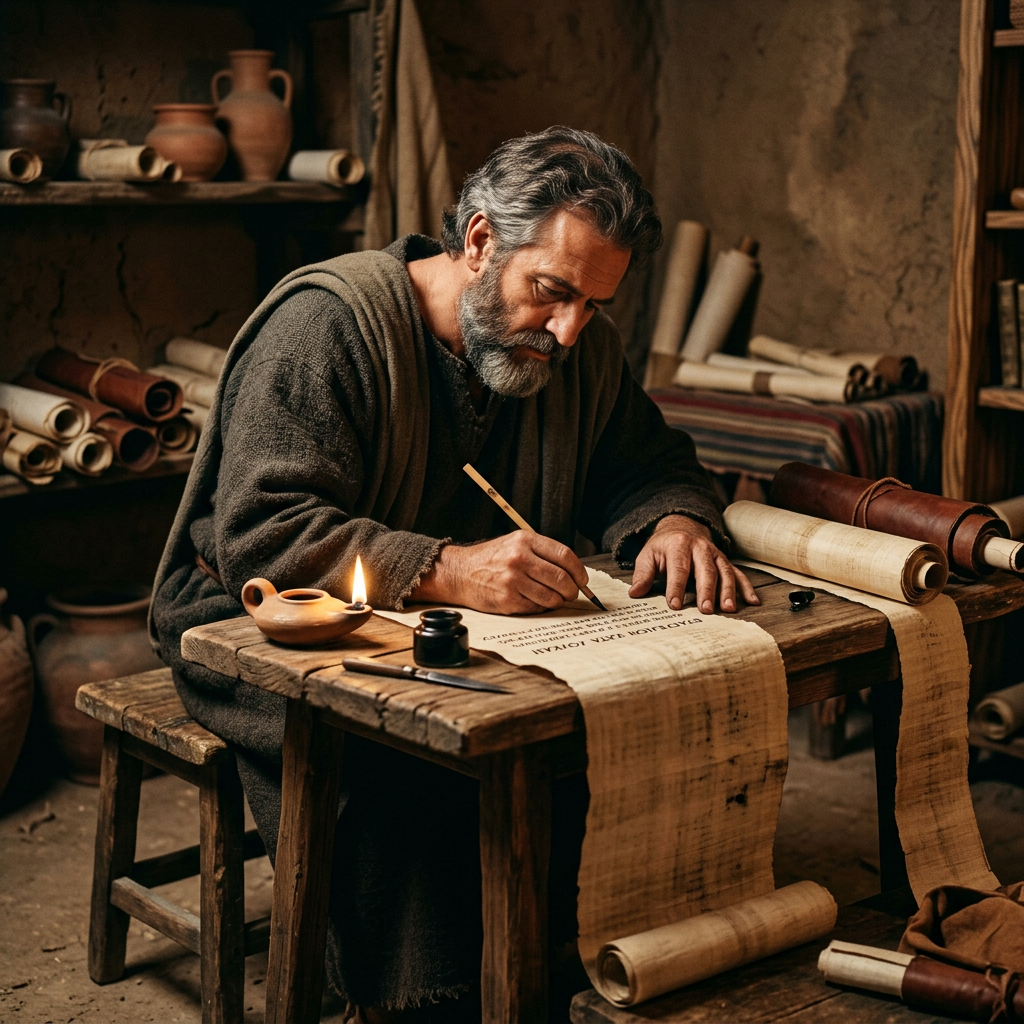
Imagine waiting your entire life for one moment, praying for something you’ve long since stopped expecting to happen, and then having an angel show up to tell you it’s happening anyway. That’s exactly where Luke chapter 1 begins — and it’s just the first of several stunning encounters between ordinary people and the extraordinary plans of God.
Luke’s Gospel doesn’t open with shepherds or a stable. It opens with a courtroom-worthy introduction, a childless elderly couple, and a young woman who’s about to have her whole life turned upside down. If you want to understand why the rest of Luke’s Gospel — and the book of Acts — unfolds the way it does, this chapter is where the story really starts.
Here’s a verse-by-verse walk through Luke 1, written for anyone doing a personal or group Bible study who wants the historical context and the “why” behind the details.
Why Luke Wrote the Way He Did
The first four verses of Luke’s Gospel are, in the original Greek, a single sentence — written in a formal, academic style. It’s almost as if Luke is establishing his credentials before he even starts telling the story.
But then something interesting happens: for the rest of the Gospel, Luke drops the scholarly language and starts writing like an ordinary person talking to ordinary people. It’s as though Luke is saying, “This account has all the proper academic and scholarly credentials — but it’s written for the man on the street.” Luke wasn’t trying to impress anyone with his vocabulary. He wanted people to understand Jesus.
Luke Wasn’t Writing From Scratch
By the time Luke sat down to write (verses 1–2), most Christians already knew the basic story of Jesus’s life — through oral tradition passed down by the original disciples, and through biographies that were already circulating. Luke may have been referring to the Gospels of Mark and Matthew (John’s Gospel came later), or possibly to other accounts about Jesus that never made it into the biblical canon.
Having likely read both Matthew and Mark’s versions, Luke set out to write a third account — one shaped specifically for a Gentile audience (verses 3–4).
Who Was Theophilus?
Luke addressed his Gospel to a man named “most honourable Theophilus” — a title suggesting Theophilus was probably a Roman official. But while the letter was addressed to one man, it was clearly written with a much wider readership in mind.
A personal theory worth considering: Both this Gospel and its sequel, the book of Acts, may have functioned as a kind of defence brief for the apostle Paul, Luke’s close friend. At the time, Paul was awaiting trial in Rome — a trial that could end in his execution simply for being a Christian.
Throughout Luke and Acts, Luke goes out of his way to show that Christianity is the natural continuation of Judaism, not a threat to Rome. This mattered enormously, because Judaism was a legally recognised religion under Roman law, while Christianity’s legal status was still very much undecided. Paul’s case was about to set a landmark precedent.
Setting the Scene: Herod, the Temple, and a Priest Named Zacharias
Luke 1:5–6 introduces us to the world Jesus was born into — starting with Herod the Great.
Herod wasn’t a descendant of Israel. He came from the line of Esau, Jacob’s brother, making him an Edomite. He’s remembered for his massive building projects, the most famous being his renovation of the modest Second Temple (built after the Israelites returned from exile in Babylon) into the grand structure known as Herod’s Temple — the very temple we read about throughout Jesus’s life.
We’re also introduced to Zacharias, a priest from “the priestly order of Abijah.” Every high priest in Israel descended from Aaron, Moses’s brother, and the priesthood was divided into 24 different orders, each tracing back to one of Aaron’s descendants.
The Weight of Childlessness
Verse 7 tells us Zacharias and Elizabeth had no children. It’s hard for us today to grasp the full weight of that reality in the ancient world. In Biblical times, infertility carried not just heartbreak but shame — many believed that if a couple couldn’t conceive, it was a sign of God’s punishment for some unconfessed sin.

A Once-in-a-Lifetime Honor
By the time of Jesus, there were reportedly as many as 20,000 priests serving in Israel. Because of that sheer number, priests drew lots to determine who would serve and when (verses 8–10). Serving in this particular role — burning incense in the temple — was something a priest could experience only once in his lifetime.
For a devoted man like Zacharias, this would have been the pinnacle of his life’s ministry. It’s easy to imagine him asking other priests who’d already served what it was like, hungry for any hint of what a spiritual encounter with God might feel like.
The morning sacrifice followed a precise ritual, determined by three separate lots:
First lot — determined who would cleanse the altar and prepare its fire
Second lot — determined who would kill the morning sacrifice and sprinkle the altar, the golden candlestick, and the altar of incense
Third lot — determined who would offer the incense itself, the most privileged duty of all
Unlike the first two roles, which were repeated at the evening sacrifice, the incense-offering was a true once-in-a-lifetime opportunity.
Before dawn, hundreds — maybe thousands — of worshippers would gather at the temple. When the incense priest approached, he’d strike a gong-like instrument, signalling the Levites to prepare for worship. Outside, the crowd would kneel in silent prayer, knowing that at that very moment, the incense priest stood in God’s presence, praying on behalf of the entire nation. A profound silence would fall over the temple grounds while this happened.
It was during this sacred silence that everything changed for Zacharias.
An Angel, a Promise, and an Old Man’s Doubt
Picture Zacharias with his eyes shut, deep in prayer, when he opens them to find an angel standing before him (verses 11–17). This wasn’t some gentle, romantic vision — angels in Scripture are typically described as awesome and even terrifying figures. No wonder the first thing this angel says is, “Do not be afraid.”
The angel tells Zacharias that God has heard his prayer, and Elizabeth will give birth to a son. But here’s the twist: it’s doubtful Zacharias had actually been praying for a child at that moment. He and Elizabeth were both elderly, and they’d likely given up on that particular prayer long ago. More likely, Zacharias was praying for something bigger — the salvation of Israel, the coming of the promised Messiah.
Zacharias didn’t yet realise God was about to answer both prayers at once, using his own miracle child to help pave the way for the Messiah.
The angel also tells Zacharias that his son must never touch wine or alcohol — almost certainly a reference to the Nazirite vow found in Numbers 6. Their son, John, would be consecrated to God for his entire life, much like the judge Samson should have been.
“Do You Know Who I Am?”
Zacharias’s response (verses 18–20) wasn’t unbelief exactly — it was more that the promise felt too good to be true. Perhaps, after years of disappointment, he’d learned to protect his heart by keeping his expectations low.
What follows is essentially the original “do you know who I am?” moment in Scripture, as the angel identifies himself and rebukes Zacharias’s doubt by striking him mute until the child is born.
Zacharias’s unbelief didn’t cancel God’s promise — it just kept him from fully enjoying the process leading up to it. It’s worth pausing here: many of us wouldn’t consider silence about our faith much of a punishment at all. Zacharias’s story is a quiet challenge to that comfort.
Struck Silent, But Not Silenced Forever
Custom dictated that the officiating priest would emerge from the temple promptly to reassure the waiting crowd that he hadn’t been struck dead in God’s presence (verses 21–23). When Zacharias finally came out — unable to speak — the crowd grew uneasy. He was supposed to pronounce a blessing over them from the temple steps. Instead, he could only communicate through hand gestures, doing his best to explain what had just happened to him.
Verses 24–25 clarify something important: this was not a virgin birth. Zacharias and Elizabeth conceived naturally — that miracle was still to come, and it belonged to someone else entirely. Elizabeth went into seclusion, not to hide her pregnancy, but to spend time with the Lord during the season when she’d be least noticed.

Nazareth: The Town Nobody Expected
Verse 26 gives us the first mention of Nazareth anywhere in Scripture — and it’s a town that seems almost deliberately unremarkable.
Nazareth sat 15 miles from the Sea of Galilee and six miles from the nearest major road. It had no reliable water source beyond one small well in the village centre. It isn’t mentioned anywhere in the Old Testament, the Apocrypha, or even in the writings of the Jewish historian Josephus.
And yet Jesus would forever be tied to this obscure little town — known throughout his life and ministry as “Jesus of Nazareth,” his followers called “Nazarenes,” and the very sign above his cross identifying him by that name.
The Virgin Mary and an Impossible Announcement
Verse 27 raises a point worth addressing directly: over roughly the last 50 years, it’s become somewhat fashionable to question the miraculous elements of Scripture — from the parting of the Red Sea being reinterpreted as crossing a shallow “Reed Sea,” to questioning whether “virgin” is the correct translation here.
It’s true that the Hebrew word alma can sometimes mean simply “young woman.” But Luke wrote in Greek, and the Greek word he used allows no such ambiguity — it specifically means virgin.
We’re also told Mary was engaged. In Biblical times, engagement was far more binding than it is today. Once engaged, a couple was considered legally married in every practical sense, even though they lived separately while the groom prepared a home for them. Breaking an engagement required an actual divorce.
Mary’s Response: Wonder, Not Doubt
When the angel Gabriel appears to Mary (verses 28–29), her reaction — being deeply troubled by his words — reveals her humility. She wasn’t expecting to be described in such extravagant terms.
Gabriel’s message (verses 30–33) makes clear that the focus isn’t really on Mary at all, but on her son. He would be named Jesus, a common name at the time, yet he would be known not merely as Mary’s son, but as the Son of the Most High. As a woman deeply versed in her faith, Mary would have understood exactly what Gabriel meant.
Mary’s question in verse 34 — essentially, “How can this be?” — mirrors the question Zacharias asked back in verse 18. The wording is nearly identical, but the heart behind it couldn’t be more different. Zacharias asked in sceptical unbelief. Mary asked in wonder-filled faith.
The Holy Spirit “Overshadowing” Mary
Gabriel explains (verses 35–37) that the Holy Spirit will “overshadow” Mary — a phrase meaning to cover with a cloud, evoking the same visible glory and presence of God that appeared to Moses and other figures throughout the Old Testament.
This language firmly rules out any comparison to Greek mythology, where gods like Zeus were said to physically mate with mortal women to produce demigods like Hercules. Nothing about Mary’s conception resembled that kind of story.
Gabriel also tells Mary that her child “will be called the Son of God” — language that doesn’t carry the same weight for modern readers as it did for a first-century Jewish audience. In that culture, being called “the son of” something meant being its equal. So this child would be understood as equal to God himself.
As proof that nothing is impossible with God, Gabriel points to Elizabeth, Mary’s relative, who — despite her advanced age — was already six months pregnant.
A Costly “Yes”
Mary’s response in verse 38 is almost too easy to read past quickly. Getting pregnant while engaged to another man could have meant death for Mary under the law of the time, or at the very least, a lifetime of rumour and suspicion about her character. In fact, even once Jesus was fully grown, some still claimed Mary had been assaulted by a Roman soldier and that Jesus was the result. Mary said yes to God’s plan knowing full well what it might cost her.
Two Expectant Mothers, One Extraordinary Song
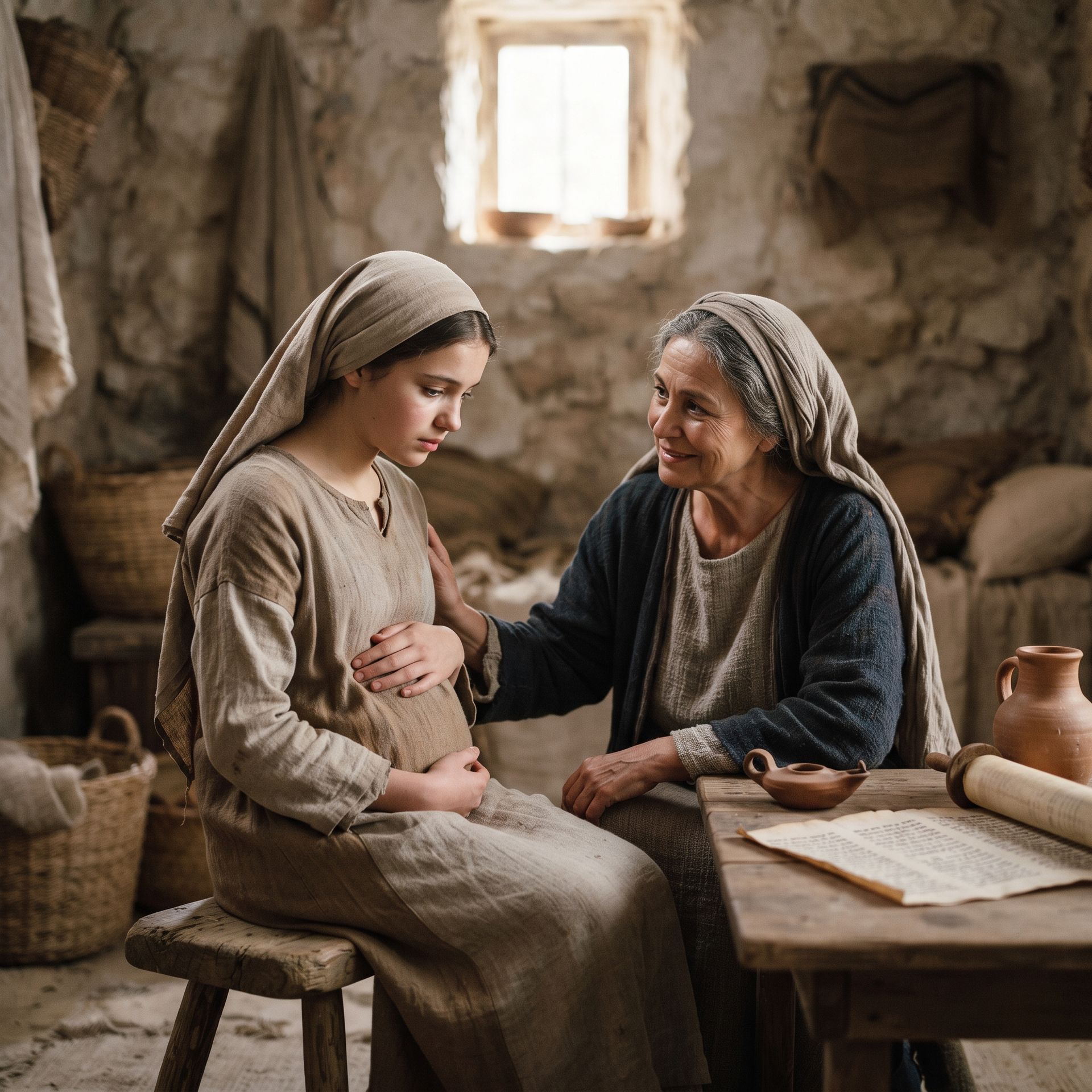
Mary, upon hearing that Elizabeth was pregnant, travelled somewhere between 80 and 100 miles from Galilee to the hill country of Judea to see her (verses 39–41).
At this point, John the Baptist hadn’t been born yet, and Zacharias was still unable to speak. And yet Elizabeth clearly believed the word the Lord had given her husband in the temple — that their son would prepare the way for the coming of the Lord (verses 42–45).
Mary’s response to Elizabeth’s greeting is the song we now call the Magnificat, named after the Latin translation of its opening words (verses 46–56). It closely echoes Hannah’s song of praise in 1 Samuel, and it’s woven through with references to the Old Testament — clear evidence of just how deeply Mary knew her Scriptures.
The Birth of John the Baptist
When it came time for Elizabeth to give birth, friends and local musicians would gather near the house, waiting for news (verses 57–66). If the baby was a boy, the musicians would break into celebratory song. If it was a girl, they’d quietly slip away.
When family and friends assumed the baby would be named Zechariah after his father, Elizabeth firmly insisted, “No! His name is John!” Both she and Zacharias already knew this was the name the angel had commanded.
The people, still treating the mute Zacharias as though he were also deaf, made signs asking what he wanted to name the child — likely an ongoing source of frustration for him. Zacharias wrote, confirming the name John, not as a suggestion but as a settled fact.
Immediately, just as Gabriel had promised, Zacharias could speak again. Fittingly, his first words were praise to God. His months of forced silence hadn’t left him bitter — if anything, it deepened his trust in God at every turn.
Zacharias’s Prophecy and a Silent Voice Returns
Verses 67–79 mark something remarkable: after 400 years without a prophetic voice from God, the Lord suddenly speaks — first through Elizabeth, then through Mary, and now through Zacharias. Every word points back to the same theme: the coming of Jesus and his work of redemption.
John’s Early Life in the Wilderness
The chapter closes with a brief but significant note (verse 80): John likely lost both his parents at a young age, given their advanced ages at his birth. Many believe he was raised among the Essenes.
The Essenes were a Jewish sect somewhat similar to the Pharisees, known for lives of ritual purity and deliberate separation from mainstream society. They emerged around 100 B.C. and disappeared from history after the destruction of Jerusalem in A.D. 70. While Scripture never mentions them by name, some scholars believe references to them may appear in Matthew 19:11–12 and Colossians 2:8, 18, and 23. Interest in the Essenes surged again after the discovery of the Dead Sea Scrolls, which were likely recorded and preserved by this very community.
The Bigger Picture
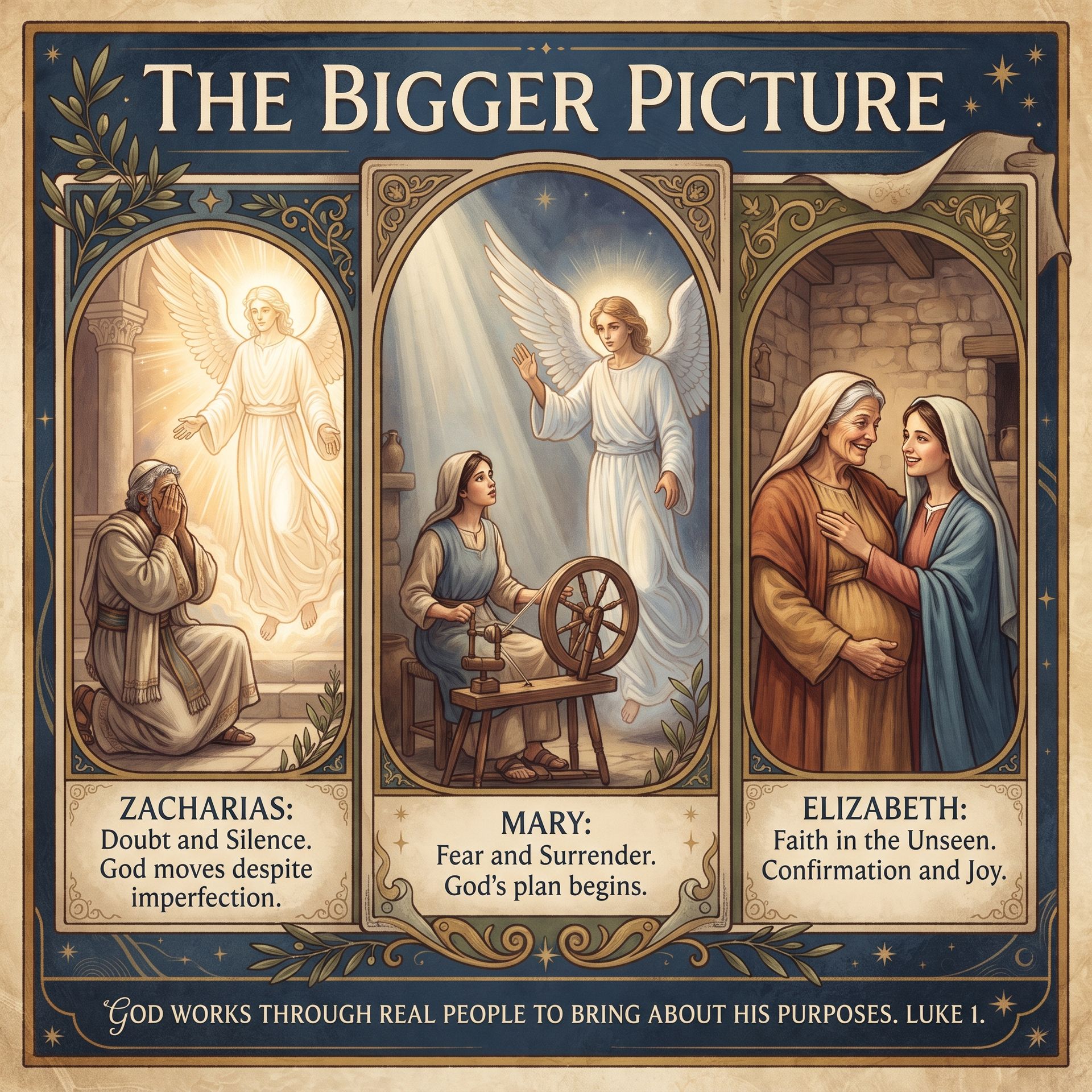
Luke 1 isn’t just background information before the “real” Christmas story begins. It’s a chapter built entirely around ordinary people — an elderly priest, his once-barren wife, a teenage girl from a forgotten town — being caught up in a plan far bigger than themselves.
Zacharias doubted and was silenced, yet God still used him. Mary trembled at the angel’s words, yet said yes anyway. Elizabeth believed a promise she couldn’t yet see fulfilled. Each of them responded imperfectly to an impossible situation, and God worked through all of it.
That’s really the heart of Luke’s opening chapter: God doesn’t wait for perfect faith before he moves. He works through real people, in real fear and real doubt, to bring about his purposes.
If you’re studying Luke’s Gospel, take time to sit with this chapter before moving on. The rest of the story — Jesus’s birth, ministry, death, and resurrection — is built on the foundation laid right here.