

In this article we’re going to take a closer look at one of the most overlooked sections of the Bible. At first glance, it seems like nothing more than a long list of instructions with little relevance to our lives today, so most people simply skip over it.
But tonight, we’re going to do the opposite.
We’re going to explore the Tabernacle and discover why God devoted so much of Scripture to it—and why it still has something important to teach us today.
So far, Moses has led the Israelites out of Egypt after the first Passover. God miraculously parted the Red Sea, allowing them to escape Pharaoh’s army. They then arrived at Mount Sinai, where Moses went up the mountain to meet with God. There, he received the Ten Commandments, and the people entered into a covenant with God, promising to obey Him as His chosen nation.
It was at this point that God gave Moses detailed, step-by-step instructions for building the Tabernacle.
To appreciate just how significant this was, consider this: the story of God’s creation of the universe—the heavens, the earth, the animals, and humanity—is told in just two chapters of Genesis. But God devotes fifty chapters across the books of Moses to the Tabernacle, its design, its priesthood, its sacrifices, and its worship.
That should make us stop and ask, why? Why would God devote so much of His Word to what appears to be a tent in the wilderness?
The answer is that the Tabernacle was far more than a building.
This would be the first time since Adam and Eve in the Garden of Eden that God would dwell among His people on earth. But there was one major difference now—sin.
Humanity had fallen. God’s holiness and our sinfulness could not simply exist together. In His perfect holiness, sinful people could not come into His direct presence without being consumed. It’s like a dry leaf thrown into a fire—it simply cannot survive.
So, in His mercy, God provided a way. The Tabernacle was the place where His presence could dwell in the midst of His people without destroying them.
And that’s why the Tabernacle matters. It isn’t just an ancient tent or a list of outdated instructions—it is one of the clearest pictures in the entire Bible of God’s desire to dwell with His people and His plan to make that possible through Christ and His work on the Cross.
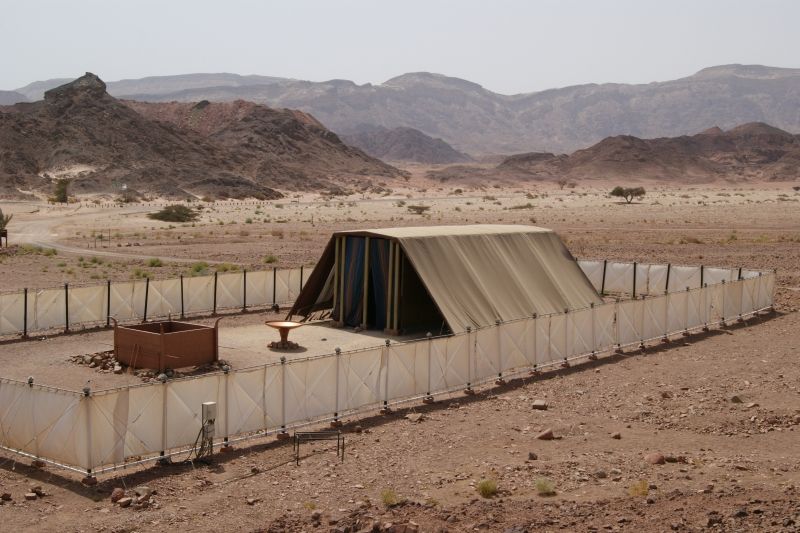
When you look at the image the entire structure was laid out in three distinct zones: the Outer Court, then the Tabernacle and within the Holy Place, and then the Holy of Holies.
From the outside, the Tabernacle would not have looked beautiful. Its outer covering was made from animal skins. To someone looking at it from the outside, it may have appeared rough, weathered, and even unattractive. There was no outward splendour to draw the eye. But that was the point. The true beauty of the Tabernacle was not found on the outside. Its beauty was found within—in the presence of God.
And there is a lesson here for us as Christians today.
The world often judges by appearances. We look at what is visible: how someone looks, what they wear, their success or how impressive their life appears from the outside.
But God does not look at people in the same way. As God said to Samuel:
“The Lord does not look at the things people look at. People look at the outward appearance, but the Lord looks at the heart.”
Now in the Outer Court, everything is made of bronze, representing judgment and endurance. As you move into the Holy Place, the foundations are made of silver, the metal associated with redemption.
But when you enter the Holy of Holies, everything is overlaid with pure gold, representing God’s divine perfection.
The closer you come to God, the more the Tabernacle reflects His holiness.
But, the access narrows as well.
Anyone from the camp of Israel could enter the Outer Court to bring a sacrifice. Only the priests could enter the Holy Place. And only one man—the High Priest—could enter the Holy of Holies, and only once a year, on the Day of Atonement, and never without the blood of a sacrifice. The Tabernacle was teaching Israel a profound truth:
God is accessible, but He is never casual. You cannot approach Him on your own terms. You must come His way. That lesson begins at the very entrance.
The entire Tabernacle was surrounded by a white linen fence, standing about seven and a half feet high. You couldn’t see over it, and you couldn’t crawl under it.
That white linen represented the perfect righteousness of God. It formed a clear boundary between sinful humanity and holy ground.
Significantly, the gate was on the east side—the same direction from which humanity had been barred from Eden. Yet here, there was a gate. One entrance. One way back into God’s presence.
Woven into its fabric were four colours: blue, purple, scarlet, and white linen. These weren’t chosen for decoration. They were a portrait of the coming Messiah. Blue speaks of His heavenly origin. Purple declares His kingship. Scarlet points to His sacrificial blood. White represents His perfect righteousness and sinless humanity.
Centuries later, a man stood in the dusty streets of Judea and said,
“I am the gate. Those who come in through me will be saved” John 10:9
And later He told His disciples,
“I am the way, the truth, and the life. No one can come to the Father except through me” John 14:6
Jesus is the fulfilment of the eastern gate and through Him, the way home is opened once again.
Once you stepped through the gate, the very first thing you encountered wasn’t a priest reading a sermon, and certainly not a quiet place for prayer.
The very first thing you saw was a slaughterhouse.
Standing directly in front of you was the Bronze Altar, also known as the Altar of Burnt Offering.
It was a massive square altar made of acacia wood overlaid with bronze, with a grate in the centre and a fire that was never allowed to go out.
Before you could go any further into God’s presence, you first had to stop at the altar. Modern religion often tries to sanitise our approach to God. We like to talk about love, peace, acceptance, and spiritual fulfilment. But the Tabernacle confronts us with a brutal reality.
You cannot approach a holy God until your sin has been dealt with.
And dealing with sin is a bloody business. Sin always demands death. When an Israelite sinned, they couldn’t simply say, “I’m sorry.” They had to bring an animal from their own flock—a lamb, a goat, or a bull—without blemish or defect. They would lead that innocent animal through the gate and stand before the Bronze Altar. Then they would place their hand firmly on its head.
This was an act of substitution. It was as if they were saying, “This animal now stands in my place. My guilt, my rebellion, my sin are laid upon this innocent substitute.” Then the animal was slaughtered.
The priest collected its blood in a basin and splashed it against the sides of the altar. Then the body was cut into pieces and placed upon the fire as a sacrafice.
Now think about this scene. The cries of the animals. The smell, smoke, and burning flesh. The heat of the flames. The sight of blood staining the ground.
God never intended worship at the altar to be comfortable. He intended it to be unforgettable. Every sacrifice proclaimed the same terrifying truth:
Sin brings death.
I deserve to be on that altar. Yet an innocent substitute dies in my place.
The fire on the altar represented God’s righteous judgment against sin. That judgment had to fall somewhere. Either it would fall upon the sinner…or it would fall upon the substitute. Now fast forward almost fifteen hundred years.
John the Baptist is standing beside the Jordan River. He sees Jesus’ walking toward him. He doesn’t say, “Behold the great teacher. ” or “Behold the miracle worker.”
He points at Jesus and says,
“Look! The Lamb of God who takes away the sin of the world!” John 1:29
Every Jewish person within earshot would immediately have thought of the Bronze Altar. The blood. The fire. The substitute.
John was announcing that the millions of sacrifices offered throughout Israel’s history had never been the destination. They were signposts. They were shadows pointing to the One who was to come. Jesus is the true Lamb of God. The perfect, spotless substitute. He walked willingly to Calvary and offered Himself upon the altar of the cross. There, the full fire of God’s righteous judgment against the sin of the world fell—not on us—but on Him.
The Bronze Altar is fulfilled by Christ. The sacrifice was complete. The debt was paid. The blood that could truly take away sin had finally been shed.
If you move past the Bronze Altar and continue toward the Tabernacle itself, you encounter the second piece of furniture: the Bronze Basin, also called the Laver.
It was a large basin filled with water. God commanded the priests to wash their hands and feet there every time they entered the Holy Place or approached the altar to minister. The warning was severe. If they failed to wash, they would die.
The altar dealt with sacrifice.
The basin dealt with cleansing.
But there is an interesting detail about where the bronze for this basin came from. Exodus 38:8 tells us that Moses made the basin from the bronze mirrors donated by the women.
In the ancient world, mirrors weren’t made of glass. They were made from highly polished bronze. So, when a priest approached the basin to wash, he didn’t just see water. He saw his own reflection. His hand would be covered in sweat, dirt and the blood from the sacrifices.
The basin forced him to see himself exactly as he was before he could be cleansed. And that gives us a powerful picture. The Bronze Altar and the Bronze Basin represent two distinct realities in the life of a believer. At the altar, the price of sin is dealt with. At the basin, the believer is cleansed. First came sacrifice. Then came cleansing. And that same pattern remains true for us today.
We come to Christ and receive forgiveness through His sacrifice. But God does not save us simply to leave us as we are. He continues to cleanse us, transform us, and prepare us to live in His presence.
At the Bronze Altar, the penalty of sin is paid through blood.
That is justification.
You are saved from the judgment you deserve because an innocent substitute dies in your place. But as you continue to live in a fallen world, your feet get dirty. You accumulate the dust and grime of the culture around you. You stumble. You sin. You become spiritually dirty. But you don’t need to be saved all over again. You don’t need to return to the altar and offer another sacrifice. The sacrifice has already been made.
What you do need is daily cleansing to maintain fellowship with God. That is the water of the Bronze Basin.
That is sanctification.
Jesus demonstrated this exact pattern in a remarkable physical way in the New Testament.
In John 13, in the upper room, just before His crucifixion, Jesus wrapped a towel around His waist, poured water into a basin, and began to wash His disciples’ feet. When He came to Peter, Peter recoiled.
“You shall never wash my feet,” he protested.
Jesus replied, “If I do not wash you, you have no share with me.”
Peter, as usual, went to the other extreme.
“Lord, not my feet only, but also my hands and my head!”
But listen to Jesus’ response:
“The one who has bathed does not need to wash, except for his feet, but is completely clean.” John 13:10
Jesus was showing Peter the difference between being completely cleansed and needing ongoing cleansing. You have already been bathed. The sacrifice of Christ has made you clean.
But as you walk through this world, your feet still pick up the dust. You don’t need to go back to the altar. You need to come to the basin. You need the daily cleansing that comes from walking with Christ. The Apostle Paul later explains how this cleansing takes place in our lives today. In Ephesians 5:26, he says that Christ cleanses the Church with the washing of water by the Word. The Bible is our Bronze Mirror.
This is why we need to read Scripture daily. It shows us the dirt we have picked up, the attitudes we have allowed to grow, the compromises we have made, and the sin we have tried to ignore.
But the purpose of the mirror is not to condemn us. It is to show us what needs to be washed. In the same way, reading the Bible is not meant simply to make us feel guilty. It reminds us of who we are, reveals what needs to change, and—most importantly—shows us how much God has given for us out of love.
Only after the blood of the altar and the water of the basin was a priest qualified to leave behind the harsh desert sun, lift the heavy curtain, and enter the Holy Place. And that is significant. Because the Holy Place represents fellowship with God.
When the priest finally reached the heavy woven curtain and crossed the threshold into the first room of the Tabernacle, the shift was immediate. Outside, in the Outer Court, it was loud. The animals, the massive fire. The voices of worshippers. The smell of burning meat, blood, and smoke. The blinding glare of the desert sun.
But the moment the curtain fell shut behind the priest, he was plunged into an entirely different world. The harsh desert wind was shut out. The noise of the courtyard disappeared. The smell of burning flesh was replaced by the intoxicating, sweet aroma of sacred incense. And there was no natural light.
The sun was completely blocked by the thick layers of animal skins and woven linen that formed the roof of the Tabernacle. The only illumination in this sacred room came from the golden glow of the Lampstand.
This room represented something humanity had not experienced since Eden: peaceful fellowship with the presence of God. You do not remain in the Outer Court forever. You pass through it.
This is where God feeds His people. This is where He gives them light. This is where He listens to them. And the first thing the priest would see was the Golden Lampstand.
Standing on the south side of the Holy Place was the Menorah—the seven-branched golden lampstand. God’s instructions for making it were astonishingly specific.
It was not to be cast in a mould. It was to be hammered and beaten out of a single piece of pure gold, weighing approximately one talent—around 75 pounds. It had a central shaft with three branches extending from each side, creating seven lamps in total.
But God commanded the craftsmen to design it to look like a living, flowering almond tree. It was to include cups shaped like almond blossoms, with buds and flowers worked into the gold.
But why a tree?
Because God is constantly weaving His story together. When humanity was exiled from Eden, we lost access to the Tree of Life. And now, inside the Holy Place, God places a stylised, glowing golden tree. It is a promise wrapped in gold:
The life you lost in the garden is going to be restored.
The Lampstand was the only source of light in the Holy Place.
If the lamps went out, the priest would be serving in complete darkness. So the lamps had to be maintained continually. They were fuelled by pure crushed olive oil, brought by the people and tended regularly by the priests.
Throughout Scripture, olive oil is closely associated with the empowering presence of the Holy Spirit. The Lampstand shines because the oil fuels the flame.
But look at the Lampstand itself. It was made of gold—a picture of divine glory.
The gold was not simply poured into a mould. It was beaten into shape.
And that gives us a remarkable picture of Jesus. The divine Son of God took on human flesh. He was beaten. He was crushed. He was wounded by the cruelty of men and bore the judgment of God against sin. And yet, through that suffering, the Light of the World came shining into the darkness.
In John 8:12, Jesus stood in the Temple courts during the Feast of Tabernacles, a celebration that included the lighting of massive lamps. And He declared:
“I am the light of the world. If you follow me, you won’t have to walk in darkness, because you will have the light that leads to life.”
He was not simply using a metaphor. He was pointing back to the Tabernacle, declaring: I am the Lampstand. I am the true Light—the only Light that can guide you through the darkness of this world.
And just as the lampstand needed oil to shine, Jesus carried out His ministry in the power of the Holy Spirit.
Next to the lamp directly across from the Lampstand, on the north side of the room, stood another piece of furniture: the Table of Showbread, also called the Bread of the Presence.
It was a small low table made of acacia wood and overlaid with pure gold. Every Sabbath, the priests would bake twelve fresh loaves of unleavened bread and arrange them on the table in two rows of six.
The Hebrew name for this bread is lechem ha-panim, which literally means “the bread of the presence.”
And the name is significant. In the ancient Middle East, you did not share a meal and break bread with a stranger. To share a meal with someone was an act of intimacy and peace. It was a way of saying: We are at peace. We belong together. We are family.
So, by placing a table in the Holy Place, God was declaring a truth: “I don’t just want your sacrifices. I want your fellowship.” The twelve loaves represented the twelve tribes of Israel. God was symbolically inviting the entire nation to sit at His table.
The bread sat continually in the presence of God, illuminated by the golden Lampstand—a picture of unbroken communion. Every Sabbath, the old bread was removed and eaten by the priests, and fresh bread was placed before the Lord.
Centuries later, Jesus stood before a massive crowd that He had miraculously fed with five barley loaves and two fish. The people wanted more physical food. But Jesus looked at them and made a statement that shocked the religious leaders:
Jesus replied, “I am the bread of life. Whoever comes to me will never be hungry again”. John 6:35
Jesus was telling them that the bread in the wilderness and the Table of Showbread in the Tabernacle were both pointing forward to Him. Jesus is the Bread of the Presence. He is the One who sustains our spiritual lives.
And through Him, fellowship with the Father is no longer available only to a handful of priests on one day of the week. It is available to anyone, anywhere, who will come to Him. But there is one final piece of furniture in the Holy Place.
As the priest moves deeper into the room, he comes to the Altar of Incense.
It stands directly in front of the heavy curtain separating the Holy Place from the Holy of Holies. The Altar of Incense was made of acacia wood and covered in gold. But unlike the Bronze Altar in the Outer Court, no animals were sacrificed here. No blood was spilled.
Twice a day—at morning and at twilight—the priest would take a specially prepared mixture of sacred spices and place it on the altar. The recipe included spices mixed together with frankincense. As the incense burned, the smoke would billow upward, filling the Holy Place with a thick, sweet-smelling cloud. And that cloud would rise and drift through the curtain into the Holy of Holies, into the very presence of God.
Psalm 141:2 gives us the meaning of this ritual:
Accept my prayer as incense offered to you, and my upraised hands as an evening offering.
The Altar of Incense represented the continual prayers of God’s people ascending into His presence.
But there is one detail about the coals used on this altar that is easy to miss—and it helps explain the whole meaning of prayer.
Where did the priest get the fire to burn the incense? God commanded that the coals used on the Altar of Incense had to come directly from the Bronze Altar of Sacrifice in the Outer Court. Think about that.
You could not offer the incense of prayer to God using just any fire. The fire of prayer had to be ignited by the fire of sacrifice. Your prayers are acceptable to a holy God because they are grounded in the blood of the substitute.
Without the sacrifice, there is no fire. Without the fire, there is no incense. And without the incense, there is no fragrant offering rising into the presence of God. Our prayers do not reach heaven because we pray perfectly. They reach heaven because they are carried by the perfect sacrifice of Jesus Christ. Today, we do not need a golden altar or burning spices. The New Testament reveals that Jesus Himself is the fulfilment of the Altar of Incense.
Hebrews 7:25 tells this when it says
“Therefore he is able, once and forever, to save those who come to God through him. He lives forever to intercede with God on their behalf. for His people.”
Right now, at this very moment, the resurrected Christ stands in the presence of the Father, continually interceding for us. His perfect intercession rises like sweet incense on our behalf. So, when our prayers feel weak, broken, or clumsy—when we don’t know what to say, or when our words seem inadequate—we can remember this: Our prayers do not stand before God on the strength of our own words. They are caught up in the perfect intercession of the Son. They are fuelled by the completed sacrifice of the Cross. And they are presented flawlessly before the Father through Jesus Christ.
The fire comes from the altar. The incense rises before God. And the sacrifice of Jesus is what makes our prayers possible.
Now we come to the veil.
Behind the Altar of Incense hung the most intimidating barrier on earth. This was not a thin curtain blowing gently in the breeze. It was a massive, heavy veil, woven from blue, purple, and scarlet yarn, together with fine, twisted linen. And woven directly into this enormous barrier were images of cherubim—the same guardians God placed at the entrance to Eden with a flaming sword.
The message of the veil was impossible to miss:
Keep out.
Behind that curtain was the unshielded, presence of the Creator of the universe. The Holy Place was a place of fellowship. But the Holy of Holies was the throne room. If a sinful human being entered that room casually, they would not survive the holiness of God.
The veil was not simply keeping people out. It was protecting them from a holiness they could not survive.
For approximately fifteen hundred years, that barrier stood between humanity and the direct presence of God. Only one man could pass through it. The High Priest. And only once a year. On Yom Kippur—the Day of Atonement.
He would enter trembling, hidden within a cloud of incense, carrying the blood of a sacrifice. But then, one Friday afternoon in Jerusalem, outside the city walls, the ultimate High Priest hung upon a Roman cross. And Matthew records the moment with staggering precision:
Then Jesus shouted out again, and he released his spirit. At that moment the curtain in the sanctuary of the Temple was torn in two, from top to bottom. The earth shook, rocks split apart Matthew 27:50–51
Notice the direction. From top to bottom. It was not torn by rioting crowds. It was not ripped apart from the floor upwards. It was torn from the top down.
God Himself had reached down from heaven and torn apart the barrier that had stood between His presence and humanity for centuries. The veil was gone. And the writer of Hebrews explains exactly what this means:
And so, dear brothers and sisters, we can boldly enter heaven’s Most Holy Place because of the blood of Jesus. By his death, Jesus opened a new and life-giving way through the curtain into the Most Holy Place….” Hebrews 10:19–20
The thick, woven curtain was a physical picture of the body of Jesus Christ. When His body was torn on the cross, the barrier between God and humanity was torn down. Completely. Permanently. Entirely.
The way back to the presence of God had been opened. The way back to Eden was no longer blocked. The cherubim no longer stood between humanity and the presence of God. The veil was torn.
And now, if you had the courage to walk past that torn veil and step into the darkness and silence of the Holy of Holies, you would find only one object.
The Ark of the Covenant.
The Ark of the Covenant was a wooden chest overlaid with pure gold, inside and out.
It had a solid gold lid, and on top of that lid were two golden cherubim facing one another, their wings spread wide and looking down toward the centre.
This was the focal point of Israel’s entire worship system. It was the earthly footstool of God’s throne.
But to understand the terrifying beauty of the Ark, you have to look at what was kept inside it—and what was placed above it.
Inside the Ark, God commanded Moses to place three specific things. First, the stone tablets containing the Ten Commandments. These were the second set of tablets, because Moses had shattered the first set when he came down from Mount Sinai and saw the Israelites worshipping the golden calf. The tablets represented God’s perfect law—and humanity’s continual failure to keep it.
Second, a golden jar containing manna—the miraculous bread God had sent from heaven. The Israelites had complained about God’s provision and repeatedly rejected His goodness. The manna represented God’s provision, and humanity’s rejection of that provision.
Third, Aaron’s staff. It was a dead almond branch that had miraculously blossomed during a rebellion against God’s chosen leadership. It represented humanity’s rebellion against God’s authority.
Broken law. Rejected provision. Rebellion against authority. The Ark was, in many ways, a picture of human failure.
It was Israel’s sin gathered together and placed directly beneath the gaze of a perfectly holy God. And if God looked down upon that broken law, that rejected provision, and that rebellion and justice demands judgment.
But God commanded Moses to build a lid for the Ark. This lid was made of pure gold. In Hebrew, it was called the kapporet, which we translate as the Mercy Seat. Once a year, on the Day of Atonement, the High Priest would enter the Holy of Holies carrying the blood of a flawless substitute. He would stand in the terrifying presence of God and sprinkle that blood upon the Mercy Seat—between the cherubim, directly between the holy presence of God and the broken law inside the Ark.
So when God looked down, He no longer saw the evidence of Israel’s rebellion. He saw the blood of an innocent substitute. The judgment had been satisfied. Justice had been served. And because the blood was there, mercy could be extended to the people.
The Mercy Seat is the climax of the entire Tabernacle system. It is where justice and mercy meet. It is where the guilt of the sinner is covered by the blood of the substitute. And when the Apostle Paul explains the mechanics of salvation to the church in Rome, he uses a remarkable word.
Romans 3:25 says that God put Jesus forward as a sacrifice of atonement, by His blood, to be received through faith. The Greek word Paul uses is hilastērion. And in the ancient Greek translation of the Old Testament, that is the same word used for the Mercy Seat.
Paul is telling us something extraordinary: Jesus is our Mercy Seat. He is the place where the holy justice of God meets the perfect blood of the innocent substitute. God does not simply ignore our sin. He does not pretend it never happened. The judgment is dealt with. Justice is satisfied. And because of Jesus, mercy is extended to us.
Now think about the entire Tabernacle. The bronze. The gold. The wood. The blood. The water. The bread. The light. The incense. The curtain. The Ark.
Every detail was pointing forward through the centuries.
It was all a shadow. A temporary sketch of a permanent reality that would one day step into human history. And then, in the opening chapter of John’s Gospel, the Apostle writes a single sentence that ties the entire Old Testament together with the New:
“And the Word became flesh and dwelt among us, and we have seen his glory, glory as of the only Son from the Father, full of grace and truth.” John 1:14
In English, that is a beautiful verse. But in the original Greek, it carries an even more powerful connection. The word John uses for “dwelt” is eskēnōsen.
It comes from the word skēnē, meaning tent or tabernacle.
So a more literal translation would be: “The Word became flesh and tabernacled among us.” Do you see what John is saying? God did not simply give us another tent made of animal skins and woven linen. He gave us a Tabernacle made of human flesh and blood.
Jesus is the ultimate Tabernacle. He is the East Gate—the only way to the Father. He is the Bronze Altar—the final sacrifice whose blood deals with sin. He is the Bronze Basin—the One who continually cleanses us. He is the Golden Lampstand—the Light of the World who shines into the darkness. He is the Table of Showbread—the Bread of Heaven that satisfies our deepest hunger. He is the Altar of Incense—the Great High Priest who continually intercedes for us. He is the torn Veil—whose broken body opened the way into the presence of God. And He is the Mercy Seat—the place where the justice of God is completely satisfied and the grace of God is freely extended.
The Tabernacle was never ultimately about a tent. It was always about Jesus.
And then you get to John 17 with the heading: The High Priestly Prayer. And when you understand the Tabernacle, that title suddenly becomes incredibly significant.
Now look at what Jesus is doing in John 17. He is about to go to the Cross and His final prayer is.
“Father, the hour has come. Glorify your Son, so he can give glory back to you.”
Then He prays for His disciples:
“Make them holy by your truth; teach them your word.”
But Jesus doesn’t stop there. He says:
“I am praying not only for these disciples but also for all who will ever believe in me through their message.”
Jesus is standing as the last High Priest before God. He is about to pass through the veil—not into the Holy of Holies, but into the presence of God Himself. And He will do it carrying not the blood of an animal, but His own blood.
The final sacrifice is about to be made. And because of that sacrifice, the way to God will finally be open. And what is Jesus praying for? Not simply that we would be forgiven. Not simply that we would be protected. He prays:“Father, I want them with Me.”