



A miraculous catch of fish. A leper healed by touch. A paralysed man lowered through a roof. A hated tax collector called to follow Jesus. Luke chapter 5 moves fast, but every story in it circles the same theme: Jesus doesn’t patch up the old — he brings something entirely new.
Let’s dig into what’s actually happening beneath the surface of these familiar stories.

A Crowd So Large, Jesus Needed a Boat
Luke opens at the Sea of Galilee — also known as the Sea of Tiberius or the Lake of Gennesaret, depending on who you asked, but all referring to the same body of water (verses 1–3).
The crowd pressing in on Jesus had grown so large that he had to push off from shore in a boat just to teach everyone. This wasn’t a random choice of location, either — Capernaum has a shallow beach that rises into a modest but steep hill just behind it, forming a kind of natural amphitheatre. From a boat just offshore, Jesus’s voice would carry clearly to everyone gathered on the slope.
Jesus specifically chose Simon’s boat — and that wasn’t random either. The two already had a connection: Jesus had eaten dinner at Simon’s house the night before and healed Simon’s mother-in-law there.

The Miraculous Catch of Fish
After finishing his teaching, Jesus wanted to do something in return for Simon, who’d lent him the boat (verses 4–5). It’s a small but telling detail — Peter couldn’t give something to Jesus without Jesus giving back even more in return.
Peter addressed Jesus as “Master” — a specific Greek word (epistata) that appears only in Luke’s Gospel, carrying connotations of “commander,” “leader,” or even “boss.” By using this title, Peter was signalling his willingness to take orders from Jesus.
And what an order it was: “We worked hard all last night and didn’t catch a thing. But if you say so, I’ll let the nets down again.”
Consider the situation from Peter’s perspective. He was a fisherman, as was his father before him. Fishing was done at night, since fish would scatter and hide during daylight hours. Jesus, meanwhile, was a carpenter, not a fisherman. Peter had every reasonable justification to say no. Instead, out of faith, he did what Jesus asked.
When Jesus Directs the Work, Everything Changes
The result was staggering (verses 6–7). This is the pattern we see throughout Scripture: we can labour — even labour hard — for a long time with nothing to show for it. But when Jesus directs the work, results follow. We miss out on something remarkable every time we make excuses instead of letting Jesus lead.
The catch was so large that Peter had to call other boats over to help haul it in. There’s a lesson embedded here for anyone serving in ministry today: like the early disciples, we should be willing to ask for help rather than letting pride convince us that God asked us alone to carry the load.
“Go Away From Me, Lord, I Am a Sinful Man”
Jesus had already performed a healing miracle for Peter’s mother-in-law, but somehow the fish miracle hit differently (verses 8–11). There was something about this particular sign — one Peter could fully understand as a professional fisherman — that broke through and brought him to surrender.
Peter’s response wasn’t gratitude first, but conviction: “Go away from me, Lord; I am a sinful man!” Witnessing Jesus’s power on display in such an ordinary setting made Peter suddenly aware of his own spiritual bankruptcy in comparison.
Jesus’s reply — “Don’t be afraid” — addressed something specific. Peter wasn’t afraid in a fearful, cowering sense; he held Jesus in overwhelming awe. Jesus gently redirected that awe: God wants to relate to us through love, not through fear.
Then came the calling that would define Peter’s life: “From now on you will fish for people.” No one would ever be a greater fisher of men than Jesus himself — but his plan was always to multiply the work through others. It started with these three fishermen, then twelve disciples, then hundreds, then thousands, and now millions.
Peter, along with the others, “left everything and followed him” — the normal pattern for how a rabbi trained students in that era: not through classroom instruction, but by having them follow him and learn on the job.
Healing an Untouchable Man
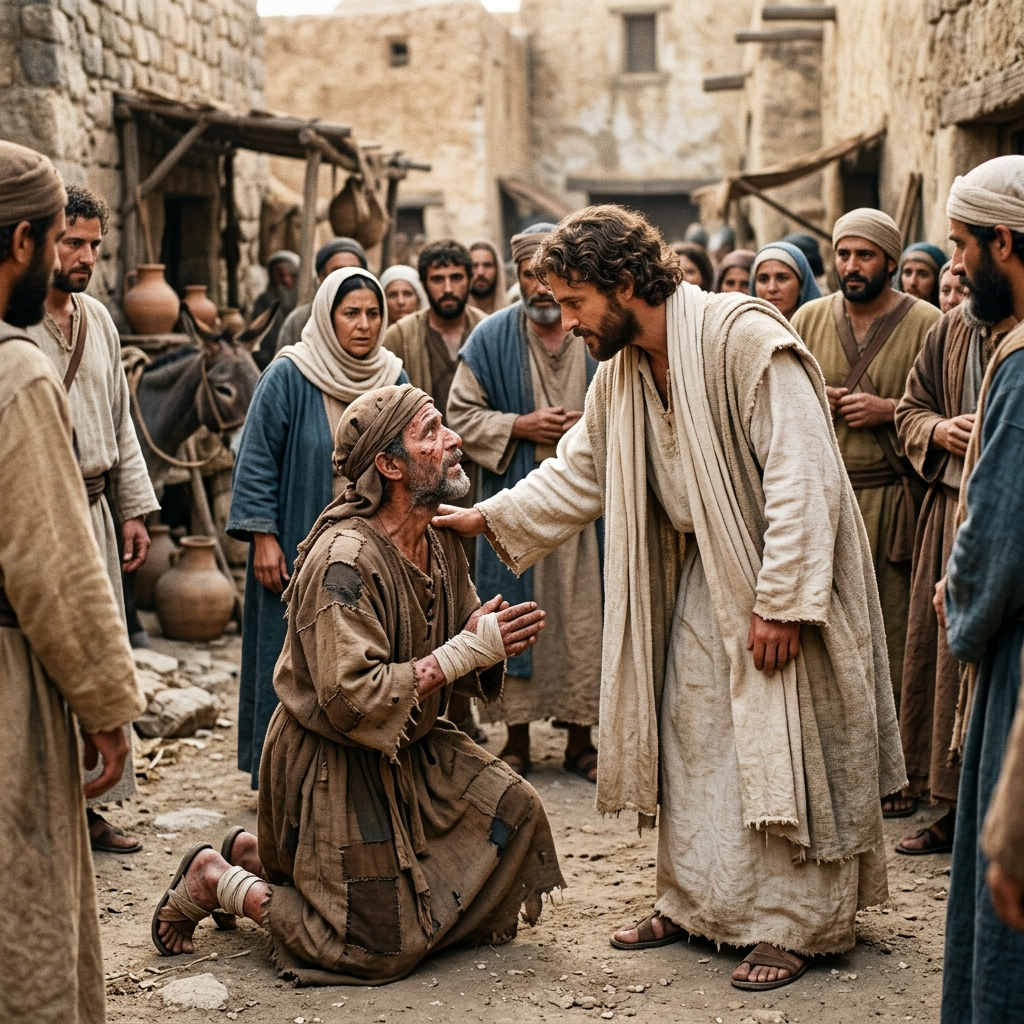
Next, Luke introduces us to a man “covered with leprosy” (verse 12) — a man with no hope of improvement, driven to Jesus purely out of desperation.
Leprosy in the ancient world was devastating. Starting as a small spot, it would slowly eat away flesh until sufferers were left with stumps where hands or legs once were. It was, quite literally, a living death — and for that reason, leprosy became a powerful picture of sin and its destructive effects. Society scorned lepers, and rabbis in particular despised them, viewing their condition as a special judgement from God, undeserving of pity or mercy.
Jewish law required people to stay at least six feet from a leper. If the wind was blowing from the leper toward someone else, the required distance jumped to 150 feet. The only thing considered more defiling than contact with a leper was contact with a dead body.
Given all this, the leper’s request is striking: “Lord, if you are willing, you can make me clean.” He had no doubt about Jesus’s ability to heal — his only question was whether Jesus would be willing. And notice his wording: he wasn’t only asking for physical healing. He wanted cleansing — freedom not just from the disease itself, but from everything the disease had cost him socially, spiritually, and personally.
Why Jesus Touched Him
Jesus didn’t need physical contact to heal this man (verse 13). He could have healed him with a word, or even a thought. Instead, he chose to heal him with a touch — reaching out to someone the entire society considered untouchable. In doing so, Jesus demonstrated something profound: rather than the leper’s impurity spreading to Jesus through contact, it was Jesus’s touch that made the man clean.
Restored to the Community
Jesus frequently instructed people to stay quiet about the healing and miracles they’d experienced (verse 14), wanting to keep the crowds’ excitement in check until the proper time for his full revelation to Israel.
The Law of Moses required specific sacrifices upon a leper’s healing — the man was to show himself to the priest, who would then sacrifice two clean birds as an offering to God. This step did more than fulfil ritual law; it also officially reintegrated the former leper back into society.
Fame Spreads, But Jesus Isn’t Chasing It
Word of this remarkable healing spread far and wide (verses 15–16). Luke doesn’t specifically say the healed leper was responsible for spreading the news, though Mark’s Gospel does make that connection (Mark 1:44–45).
Jesus quickly developed a reputation as a healer, but he never seemed to actively encourage that side of his ministry. Crowds came to hear him teach, and healing simply followed. It’s also worth noting: the widespread sickness and disease across Israel at this time was itself evidence of the nation’s disobedience to God’s covenant and the low state of their spiritual lives — consequences God had explicitly warned about in Deuteronomy 28.
Friends Who Tore Open a Roof
Back in Capernaum (see Mark 2:1), Jesus continued teaching, and this time his audience included Pharisees and teachers of the law — some of whom had travelled considerable distances from Judea and Jerusalem to hear him (verses 17–19).
Pharisees means “separated ones.” They deliberately separated themselves from anything they considered unholy. For many of them, religion centred entirely on exact, outward obedience to the law — and they believed God’s love was reserved only for those who kept it as precisely as they did.
Luke notes that “the power of the Lord was with Jesus to heal the sick” — though it’s worth remembering that there were also times Jesus performed relatively few miracles, specifically due to the unbelief of a particular audience (see Matthew 13:58).
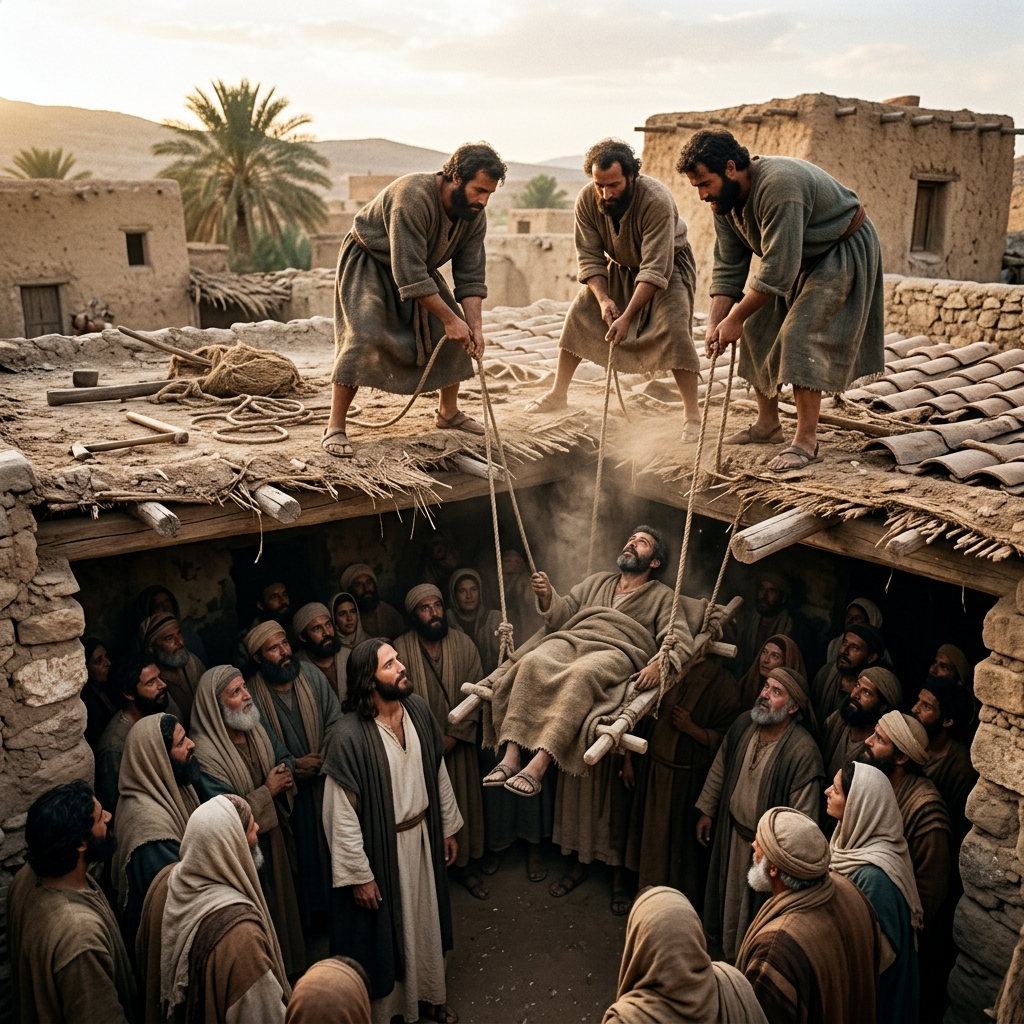
This is the scene where four friends carried a paralysed man to Jesus, only to find the crowd too dense to get near him. Rooftops in that era were typically accessible via an outside staircase and constructed from thatch and dirt packed over wooden beams — meaning they could actually be taken apart. The friends dismantled part of the roof and lowered their paralysed friend down directly in front of Jesus. This was no small effort, and it revealed real determination and faith — not to mention that getting him back up through the roof afterward would have been far harder than lowering him down.
“Your Sins Are Forgiven”
Jesus looked at these four men straining against ropes tied to each corner of a stretcher, and Luke tells us he saw their faith (verses 20–22).
Then came a surprising first response: “Friend, your sins are forgiven.” Imagine how the friends on the roof must have felt in that moment — after all that effort to get their friend physically healed, this teacher seemed, at first, only concerned with a spiritual issue.
The religious leaders in the crowd immediately objected internally: “Who can forgive sins but God alone?” And here’s the thing — their logic wasn’t wrong. Only God can forgive sins, and they were right to examine this claim carefully. Their error wasn’t in their theology; it was in refusing to recognise who was actually standing in front of them: God the Son, who holds the authority to forgive sins.
“Which Is Easier to Say?”
Jesus posed a pointed question: which is easier — to say someone’s sins are forgiven, or to say “get up and walk” (verses 23–26)? In a sense, forgiving sins was actually the “harder” claim to make, precisely because it’s invisible — no one in that room could verify in the moment whether the man’s sins were truly forgiven before God. Physical healing, on the other hand, could be instantly confirmed. Jesus deliberately chose to put himself to a test with immediately verifiable results.
And the man immediately stood up in front of everyone.
Picture the tension in that room: the Pharisees tense, because Jesus had openly challenged their theology and staked his claim to being the Son of God on a visible test. The paralysed man tense, wondering if healing would really come. The four friends tense, exhausted from their effort and hoping it would all pay off. Even the homeowner was likely tense, wondering what it would cost to repair his now-damaged roof. The only person in the room who wasn’t tense was Jesus.

Calling a Hated Tax Collector
Jesus’s next call went to Levi — also known as Matthew, the author of the Gospel bearing that name (verses 27–28).
Tax collectors in that era were despised on two fronts. First, they were seen — correctly — as traitors, since they worked directly for the occupying Roman government, backed by the force of Roman soldiers to compel payment. They were among the most visible symbols of Jewish collaboration with Rome.
Second, they were viewed — again, correctly — as extortionists. Tax collection contracts were auctioned off to the highest bidder among the Romans. Whatever a collector charged beyond what he owed Rome, he kept as pure profit. This created enormous incentive to overcharge and cheat wherever possible.
When a Jewish man entered the customs service, he became a social outcast. He was barred from serving as a judge or witness in court, excommunicated from the synagogue, and his disgrace extended to his entire family. One ancient writer even recorded seeing a monument built for an honest tax collector — a rarity so remarkable it was considered monument-worthy.
Given how universally despised tax collectors were, Jesus’s call to Matthew stands out as a remarkable act of love. In some ways, Matthew’s sacrifice in following Jesus was even greater than that of the fishermen disciples. Peter, James, and John could, in theory, return to fishing if things didn’t work out. Matthew’s old position wouldn’t have been so easy to reclaim.
Matthew “left everything and followed him” — a significant sacrifice, since tax collectors were typically wealthy men. Matthew was very likely the richest of all the apostles.
A Party for Sinners
Rather than mourning what he’d given up, Matthew celebrated (verses 29–32) — throwing a party specifically so Jesus could meet his friends. A saved man, after all, doesn’t want to go to heaven alone.
The Pharisees took issue with this, voicing their complaint not directly to Jesus, but to his disciples. Sharing a table with “sinners” in that culture was a powerful social statement — essentially declaring solidarity with a person and their way of life. It’s worth noting that the accusation came indirectly, through Jesus’s followers rather than at him personally — a pattern that hasn’t changed much today, where people often attack Jesus by attacking his followers instead.
Jesus’s answer was simple and profound: he was the doctor of the soul, and it made perfect sense for a doctor to spend time with those who are sick.

New Wine, New Wineskins
When questioned about why his disciples didn’t fast like others, Jesus responded using the imagery of a wedding feast (verses 33–38).
A wedding feast represented pure joy and celebration in that culture. During the week-long wedding festivities, joy took precedence over rigid religious rules — so much so that a popular rabbinic text called the Scroll of Fasting explicitly forbade fasting on days devoted to joyous celebrations like weddings. Jesus was saying his followers should carry that same kind of joy.
But there’s a subtle, darker note tucked into his words: “the time will come…” It’s as though Jesus was quietly acknowledging, “I threaten their entire system” — one of the earliest hints of the rejection that was coming.
Jesus then used two everyday illustrations:
- A new patch on an old garment — Unlike today’s pre-shrunk fabrics, a new patch sewn onto old cloth would shrink and pull away, tearing the garment even worse than before.
- New wine in old wineskins — Biblical-era wine was very different from modern wine. It had low alcohol content and functioned more as a natural way to purify drinking water and add flavour than as a way to get drunk. It was often boiled down into a concentrated paste, which expanded significantly once mixed with water. Pouring this expanding mixture into an old wineskin — already stretched from previous use — would cause it to burst, losing both the wine and the skin.
The point behind both illustrations was the same: Jesus was introducing a completely new covenant. Trying to force this new reality into the old system’s rules would simply cause everything to burst. The old standard of “an eye for an eye” was giving way to something new entirely — “love your enemy.”
Something New, Not a Patch Job
Just because people feel more comfortable with what’s familiar doesn’t mean the old way is better (verse 39). Jesus didn’t come to patch up the existing system. He came to introduce something genuinely new. And in doing so, he wasn’t destroying the old law — he was fulfilling it.
The Bigger Picture
Luke chapter 5 is really a chapter about surrender and transformation. A fisherman surrenders his profession. A leper surrenders his isolation. A paralysed man’s friends surrender their comfort and effort. A tax collector surrenders his wealth and reputation. And in every case, Jesus responds not by tweaking what already existed, but by offering something entirely new — new purpose, new cleanliness, new forgiveness, new community.
That’s the thread running through this whole chapter: you can’t force the new thing Jesus offers into old containers. Something has to give — and Jesus is asking each of us, just as he asked Peter, Matthew, and everyone else in this chapter, to let go of the old and step into what’s new.
As you study Luke 5, consider where in your own life you might be trying to patch an old way of living rather than fully embracing what Jesus is offering instead.