


The Gospel Of Luke
Chapter 20
(V1-2) Jesus didn’t look for these great debates with the religious leaders. He wanted to teach the people and tell them about God’s good news.
(V3-8) By replying with this question, Jesus did not evade their question. Instead, He used the question to explain who He is and to expose the hypocrisy of the leaders.
If John was from God, then he was right in proclaiming Jesus as the Messiah – and if this was true, then Jesus had all authority. Their response showed they were not really seeking the truth. They cared more about winning the argument against Jesus than in knowing the truth.
These men knew that John said Jesus was the Messiah, and were not willing to accept it, and Jesus basically said “If you do not recognize authority when you see it, then no amount of arguing will convince you of it”
(V9-16a) A man planted a vineyard, leased it to tenant farmers – This sort of tenant farming arrangement was a common practice in Jesus’ day, especially in Galilee.
planted a vineyard – This parable is rooted in the Old Testament as Jesus’ listeners would remember that the vineyard was used in the Old Testament as a picture of IsraelIsaiah 5:1-7.
In this parable, the tenants represented the religious leaders among the Jewish people.
leased it to tenant farmers – The vinedressers didn’t buy the vineyard, and they did not make it. They were allowed to work it by a generous owner – yet they turned against the owner, and one day they would answer for their rebellion..
This parable tells us that God, the owner of all, that He is more patient with rebels than we would ever be, and that there will be a final day of reckoning.
What will I do?’…‘I know! I’ll send my cherished son – The owner of the vineyard repeatedly tried to receive what was rightfully His from the vineyard and those who worked it. They rejected each of the three servants he sent to receive what was due to him, so finally he sent his beloved son, thinking ‘Surely they will respect him.’
Here comes the heir to this estate. Let’s kill him and get the estate for ourselves – The farmers would have assumed that with the arrival of the son, that the owner must had died. So if they killed the heir, the vineyard would pass into their hands as first claimants.
NOTE – In biblical times when the title of ownership of land was sometimes uncertain, anyone who had the use of land for three years was presumed to own it in the absence of an alternative claim.
This parable tells us that Jesus knew He was the Son in the parable and that He knew that He would be killed soon.
(V16b-17) How terrible that such a thing should ever happen –The religious leaders understood the parable immediately and objected that Jesus compared them to the rebellious and tenants as they knew He had spoken this parable against them. In their blindness they thought, “This could never be us.”
The stone which the builders rejected Has become the cornerstone –Jesus taught them from Psalm 118, because this Psalm described the coming of the Messiah to Jerusalem, and Jesus had been officially presented to Israel at the Triumphal Entry. The hostility of the Jewish leaders showed that this Messianic stone was being rejected, even if He was initially greeted with cheers.
Stone… chief cornerstone – Jesus is often likened unto a stone or a rock in the Bible.
- He is a cornerstone Matthew 21:43
- he is a rejected stone Matthew 21:43
- a stone of stumbling and rock of offense 1 Peter 2:7
- a living stone 1 Peter 2:4
- a precious stone 1 Peter 2:6
- a tried stone Isaiah 28:16
- a growing or increasing stone Daniel 4:34,35
- the Rock that followed Israel 1 Corinthians 10:4
The cornerstone – This is the stone used at the building’s corner to bear the weight or the stress of the two walls. It would have functioned somewhat like a ‘keystone’ or ‘capstone’ in an arch or other architectural form. It was the stone which was essential or crucial to the whole structure.”
(V18) Everyone who falls on that stone will be broken to pieces; anyone on whom it falls will be crushed – Tricky verse as there isn’t much on it.
Its speaking against the Israelites whom would have know that the stone spoken of here was used in a “stoning” as you would be first pushed of a large rock or cliff twice the height of a man then if still not killed a large stone carried by two men would then be dropped upon your chest. And it’s symbolic of what was going to happen to Jerusalem and the Jews as they would suffer for their rejection of Jesus for now 2000 years.
OR
Now upon first reading both options seem pretty bad, but if we think about it, Jesus does indeed break us, from our pride, self will and life from sin and those who refuse will be crushed by His power.
(V19) The leaders were enraged at the mere thought that they could be wrong, but could not act as the people from all over Israel and beyond had come to Jerusalem for the Passover so they too frightened of the repercussions, as any sign of civil unrest would have brought the force of the Roman army on them.
(V20-22) They tried to get Jesus to say something that could be reported to the Roman governor so he would arrest Jesus – Public opinion had kept them from stopping Jesus. Now the enemies of Christ tried to turn the tide of public opinion against Him by making Jesus appear to side with the Roman government.
Spies – The original translation is more along the idea of, “to set up an ambush” No doubt these were men of the lowest principles, and were hired by the Pharisees to do their dirty work as to keep themselves ceremonially clean.
Teacher,” they said, “we know that you speak and teach what is right and are not influenced by what others think. You teach the way of God truthfully– This was an obvious and clumsy attempt to influence Jesus with flattery. They hoped Jesus was insecure or foolish enough to be impressed by their hollow praise.
Is it right for us to pay taxes to Caesar or not?” Jesus’ dilemma with this question was simple. If He said that taxes should be paid, He could be accused of denying the sovereignty of God over Israel making Himself unpopular with the Jewish people. And if He said that taxes should not be paid, He made Himself an enemy of Rome.
NOTE – Rome had long required the Jews of Palestine to pay taxes since least since A.D. 6 they were forced to pay taxes directly into the emperor’s treasury. Some Jews such as the Zealots refused, not wanting to recognize Roman rule as legitimate. Most others reluctantly paid it.
(V23-26) He saw through their trickery – there was some exasperation in the voice of Jesus as He said this, it was not only on His own behalf. It is easy to imagine that Jesus thought, “Why do you keep testing Me when you always lose? How long will you try to get the best of Me?”
Whose picture is stamped on it? – Essentially, Jesus said “You recognize Caesar’s civil authority when you use his coins, therefore you are obliged to pay him the taxes he asks for.”
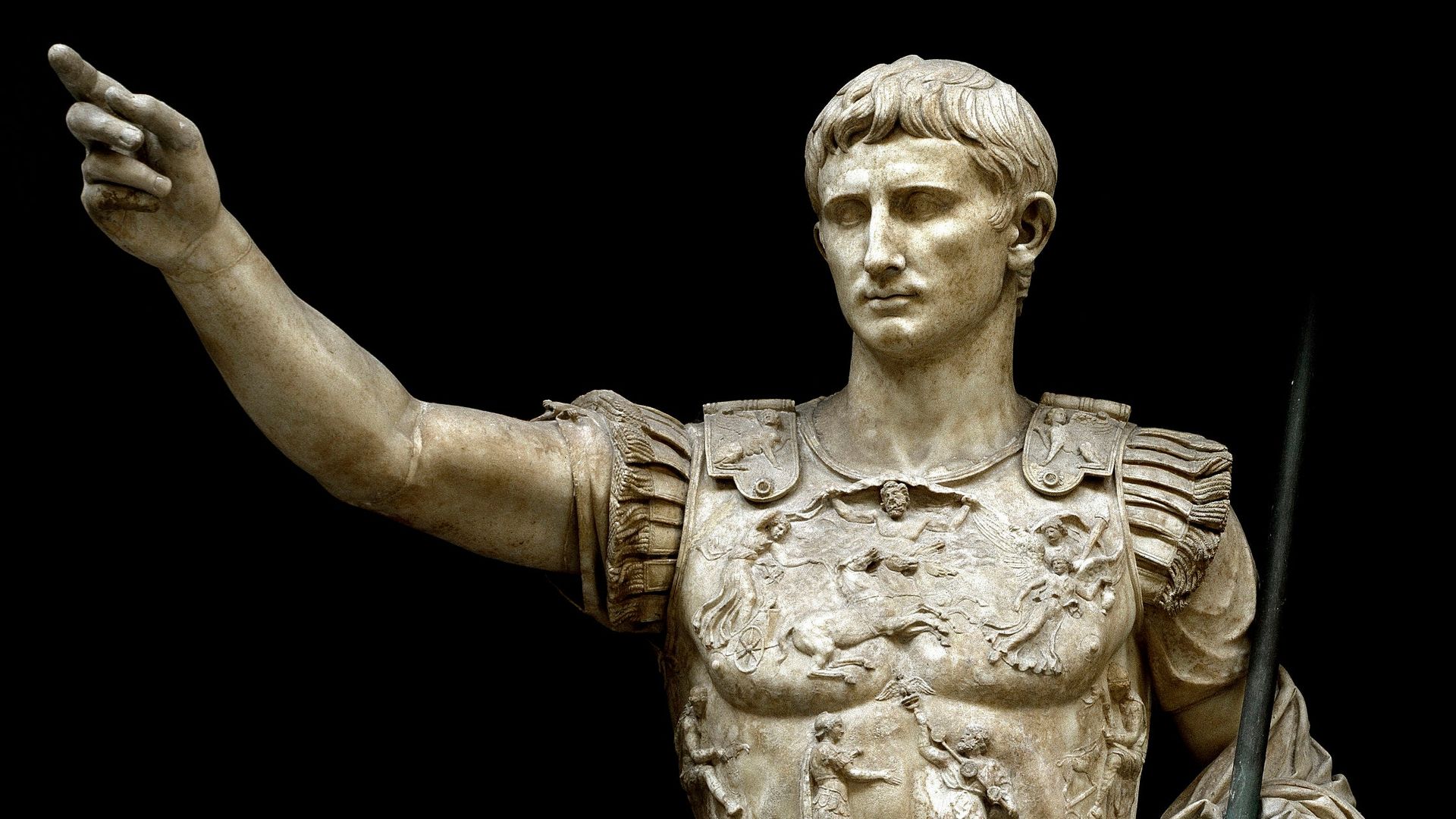
“The denarii bore the head of Tiberius. And like modern money the image and inscriptions of ancient coins would have been understood as a property seal, the coins belonged to Caesar.
give to Caesar what belongs to Caesar – Jesus tells that the government makes legitimate requests of us. We are responsible to God in all things, but we must be obedient to government in matters civil and national.
Peter said it like this – Fear God, and respect the king. 1 Peter 2:17 Jesus is saying that we are citizens of heaven and earth at the same time.
NOTE – In older translations like the KJ it uses the word Render which is probably a better translation as it means ‘give back’ and is the verb for paying a bill or settling a debt that is owed.
and give to God what belongs to God. – Everyone has the image of God in them. This means that we belong to God, not to Caesar, or not even to ourselves.
Had the Jews truly given to God what was His due, they would have never had to give anything to Caesar in the New Testament times, as they would never have had the oppression of the Roman Empire if only they had been obedient to their covenant with God.
So they failed to trap him – Jesus gave a wise and appropriate answer to their question. Nevertheless, they took this perfect answer and twisted it into an accusation in Chapter 23, when they accused Jesus of–leading our people astray by telling them not to pay their taxes to the Romewhen He actually said just the opposite
SADUSEES
The Sadducees were the ancient version of the modern liberal churches. They were anti-supernatural , only accepting the first five books of Moses as authentic – and disregarding what was written in those books when it pleased them to do so.
They did not believe in immortality, spirits or angels. They were the conservative, aristocratic, high-priestly party, worldly minded and very ready to cooperate with the Romans, which, of course, enabled them to maintain their privileged position.
(V27-33) Well, suppose there were seven brothers – The Sadducees asked Jesus a hypothetical – and ridiculous – question, hoping to show that the idea of the resurrection was nonsense. Based on Old Testament laws if a married man died childless, it was his brother’s responsibility to impregnate his brother’s widow and then count the child as the deceased husband’s descendant. The Pharisees imagined elaborate circumstances along these lines and raised the question, whose wife will she be in the resurrection?
NOTE –This practice of a brother-in-law marrying the widow of his brother is known as levirate marriage. The term comes from the Latin “lavir,” meaning “brother-in-law.” Deuteronomy 25:5-10
(V34-36) neither marry nor be given in marriage – First, Jesus reminded them that life in the resurrection is quite different from this life. It does not merely continue this world and its arrangements, but it is life of a completely different order.
This passage has made many wonder if marriage relationships will exist in heaven, or if those who are husband and wife on earth will have no special relationship in heaven. We are not told enough about life in the world beyond to answer in great detail, but we can understand a few principles.
- Family relationships will still be known in life in the world beyond. The rich man Jesus described in the afterlife was aware of his family relationships – Luke 16:27-28 .
- The glory of heaven will be a relationship and connection with God that surpasses anything else, including present family relationships – Revelation 21:22-23
they will never die again. In this respect they will be like angels. They are children of God and children of the resurrection – Jesus reminded us that life in heaven is eternal and shares some characteristics that the angels now experience – though we will be even greater, being called sons of God and sons of the resurrection, titles not given to angelic beings in the New Testament. The point is if there is no death in the life to come, there is no need for reproduction.
they will be like angels – Jesus here clearly tells that angels are real something also that the Sadducees denied.
(V37-40) Jesus demonstrated the reality of the resurrection using only the Torah; the five books of Moses, which were the only books the Sadducees accepted as authoritative. If Abraham, Isaac and Jacob did not live on in resurrection, then God could not say that He is the God of Abraham, and would instead say, “I was the God of Abraham.”
(V41-44) the Messiah is said to be the son of David and his Lord ? – When the scribes and Pharisees and Sadducees questioned Jesus, they tried to make Him look bad or trap Him. Jesus didn’t do the same with His questions to them. Instead, He got to the heart of the matter- do you really know who I am?
Jesus tested their ideas that they already knew everything about the Messiah. He asked them in love to consider that they may not know everything, and may have still have something to learn.
(V45-47) parade around in flowing robes – The teachers of the bible were men of leisure, who watched while others worked.
love to receive respectful greetings – They demanded recognition from others for their position with God.
love the seats of honour – They demand the special benefits of status and privilege.
shamelessly cheat widows out of their property – Perhaps the teachers pretended to help the widows, and instead used their position of trust to take from them. Perhaps they received gifts from well-meaning widows and mismanaged them. Perhaps they solicited gifts from widows with false promises.
NOTE – In that day, a Jewish teacher could not be paid for teaching – but he could receive gifts. And many teachers used manipulation to get big gifts from those who could least afford to give them, such as widows.
NOTE – Many of Jews of Jesus’ day taught that teachers were to be respected almost as God; they said that they deserved more honour and respect than any other people in life did. They taught that the greatest act someone could do is give money to a teacher. Of course, it was the teachers themselves who taught this! (And I think this should be reintroduced at Living Waters lol)
making long prayers in public – The teachers thought they were more spiritual because of their long prayers, but Jesus never complained about short prayers but does say
When you pray, don’t babble on and on as the Gentiles do. They think their prayers are answered merely by repeating their words again and again – Matthew 6:7
they will be severely punished. – The teachers represent a complete contrast to the picture of how a disciple should live – as a servant, as a child, as one carrying a cross. Jesus said we should notice how they live as well as what they teach.
AMEN