


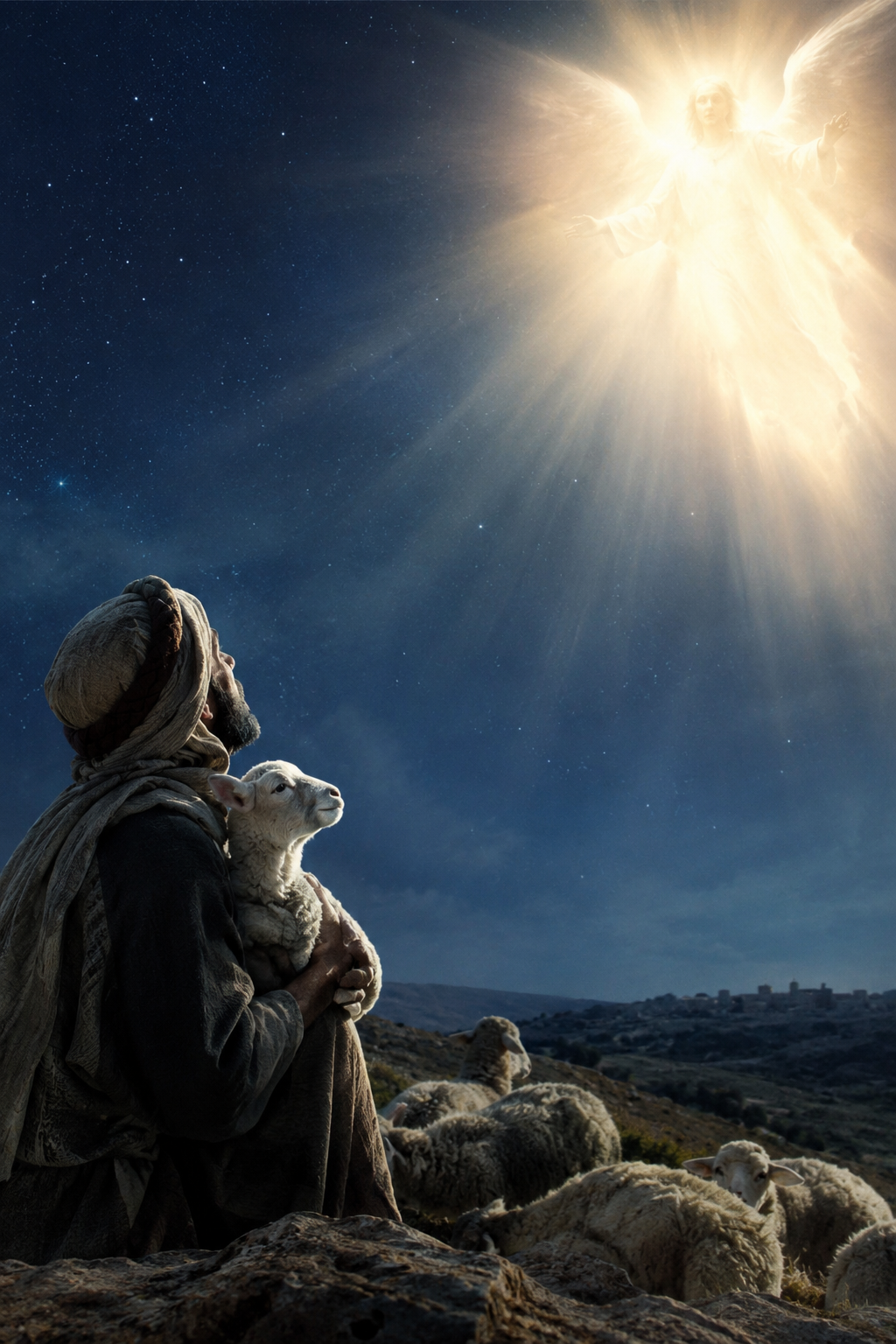
A Roman emperor issues a tax decree without a second thought. A young couple travels 80 miles on foot while the woman is heavily pregnant. A handful of shepherds — men nobody would trust as witnesses in a courtroom — become the first people on earth to hear the news that changes everything.
Luke chapter 2 is one of the most familiar passages in all of Scripture, read aloud in churches and living rooms every Christmas. But underneath the familiar nativity scene are layers of historical detail, cultural context, and quiet irony that are easy to miss on a casual read. Let’s walk through it together.
Caesar Augustus: The Most Powerful Man in the World, Unknowingly Doing God’s Work
Luke opens his account of Jesus’s birth (verses 1–3) not with angels or shepherds, but with a Roman census — and the emperor behind it.
Caesar Augustus, born Octavian, was the grand-nephew of Julius Caesar. Julius Caesar adopted him as his son and named him his official heir in 45 B.C. Within a year, Caesar was assassinated, and Octavian found himself sharing power with two other men, Mark Antony and Lepidus, as Rome split into three competing factions. Lepidus was eventually pushed out entirely.
The real turning point came in 31 B.C., at the Battle of Actium. Mark Antony, backed by Cleopatra and the Egyptian army, faced off against Octavian. Despite commanding a smaller force, Octavian won decisively, leaving him the sole ruler of the Roman world. He took the title “Caesar Augustus” — meaning “the increaser” or “the venerable.”
For the first time, the empire experienced genuine peace. Augustus wielded so much power over life, death, and entire nations that many believed he must be a god.
But here’s the irony: Augustus was really just a piece on God’s chessboard. God needed the Messiah born in Bethlehem, so all it took was a single decree — a poll tax census requiring everyone to register in their ancestral hometown — and the most powerful man on earth unknowingly set the stage for the birth of the King of Kings.
The Journey to Bethlehem
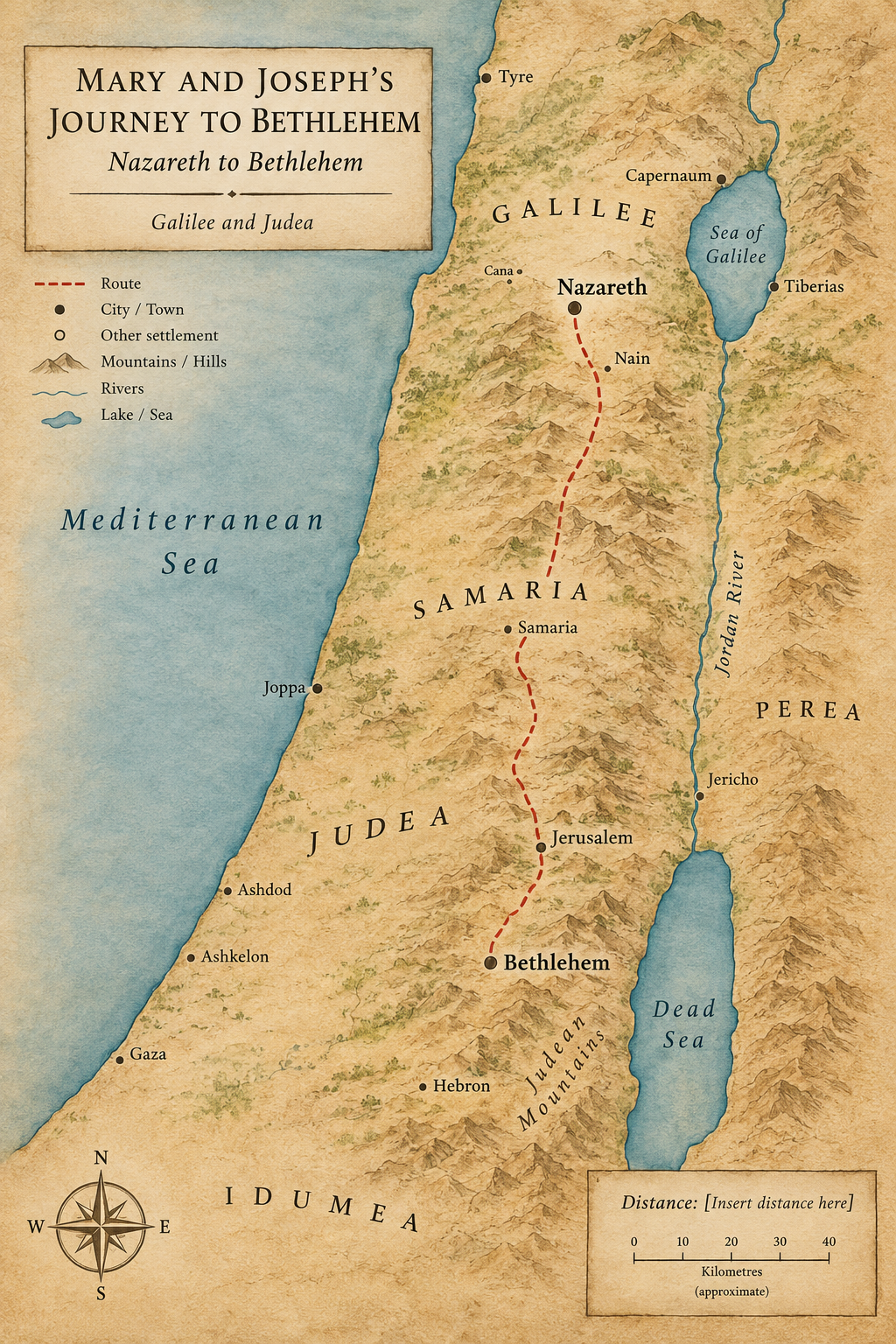
The trip from Nazareth to Bethlehem (verses 4–5) covered roughly 80 miles. Technically, Roman law didn’t require Mary to travel with Joseph for the census. But given that she was in the final stages of a pregnancy that had almost certainly become the subject of gossip back in Nazareth, it made complete sense for her to go with him.
A Humble Birth, Told Simply
One of the most striking features of Luke’s account (verses 6–7) is just how understated it is. Under the Holy Spirit’s inspiration, Luke describes the single most significant event in human history with remarkable simplicity — no dramatic flourishes, no attempt to overstate the moment.
A few details are worth unpacking:
- Swaddling cloth — The Greek word used here is the same word used for something torn. These strips of cloth had to be ripped from another garment, since there was no such thing as ready-made baby clothes. They were made on the spot, out of necessity.
- The manger — The famous manger where Jesus slept was actually a stone drinking trough for animals. Hardly a fitting crib for the King of Kings on the surface, but mangers were a common and practical choice. Once scrubbed clean and lined with hay and cloth, they made a safe, comfortable bed for a newborn.
- “No room at the inn” — This detail has become a beloved (if slightly inaccurate) part of the Christmas story, with imaginations picturing doors slamming in the face of a pregnant Mary. In reality, the word translated “inn” more accurately means guest room. Biblical homes typically had two levels — family living upstairs, animals housed on the ground floor. When guests arrived, a large curtain could be drawn across the upper room to create privacy. Mary likely gave birth upstairs, surrounded by the women of the family. Afterward, they probably moved downstairs near the animals, since that area would have been warmer for the newborn.
Shepherds: Unlikely Witnesses to the Greatest News in History
In Biblical times, shepherds were not well respected (verse 8). They were often viewed as thieves, liars, and untrustworthy — so much so that their testimony wasn’t even admissible in a courtroom.
That detail matters. If someone were fabricating this story, they wouldn’t choose shepherds as their star witnesses. And notably, this isn’t the only time in the Gospel story that “unreliable” witnesses play a central role — women, whose testimony also wasn’t considered legally valid at the time, would later be the first witnesses of Jesus’s resurrection. The pattern suggests authenticity, not invention.
There’s an even deeper layer here. These weren’t just any shepherds — they were very likely Levitical shepherds, tasked specifically with raising and tending the lambs used for sacrifice in the Jerusalem temple. In other words, the very shepherds trained to prepare sacrificial lambs were now the first to witness the arrival of the ultimate Lamb of God.
The Angels’ Announcement
Verses 9–14 describe the first “preacher” of the gospel: an angel. It’s a striking thought that this particular honour was given to angels, though Scripture elsewhere describes human ministers as being called “angels” in a spiritual sense (Revelation 2:1).
After the initial announcement, a whole multitude of angels suddenly appeared alongside the first. It’s tempting to imagine all of heaven’s angels lining up, each hoping for the privilege of announcing the Saviour’s birth — until God, like a generous father, simply told them all they could join in and sing.
The Shepherds Run to Bethlehem
The shepherds didn’t hesitate (verses 15–20) — they likely ran the whole way to Bethlehem. The angel had told them to look for a baby wrapped in swaddling clothes and lying in a manger. A baby in swaddling clothes wasn’t unusual at all. But a baby lying in a manger? That was strange enough that, without the angel’s specific instructions, they might never have believed what they were seeing.
Once they found Jesus, word of what they’d witnessed spread quickly, amazing everyone who heard it. Even those who didn’t fully grasp the significance recognised that something extraordinary had happened. It’s easy to picture the shepherds running through the streets in the middle of the night, shouting about what they’d seen.
Mary’s response was completely different. Rather than the excitement of the shepherds or the amazement of the crowd, she quietly took everything in, treasuring it and meditating on its deeper meaning.
Presented at the Temple
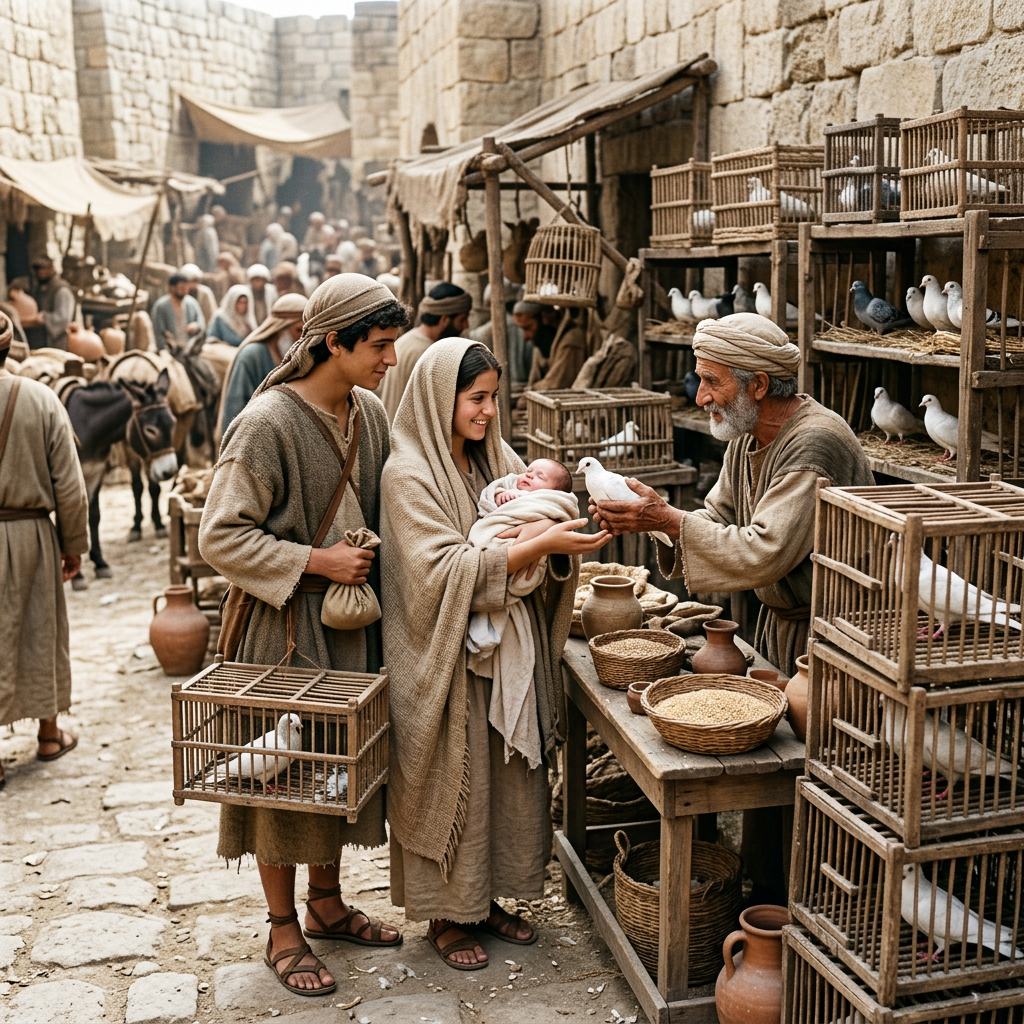
Leviticus 12 required that at the birth of a son, a lamb be offered as part of a purification and dedication ceremony — though families who couldn’t afford a lamb were permitted to offer two birds instead (verses 21–24).
This detail is more significant than it first appears. The offering of two pigeons instead of a lamb was specifically known as “the Offering of the Poor.” Since Mary and Joseph brought birds rather than a lamb, this tells us this moment happened before the wise men arrived with their gifts — otherwise, the family would have had the means to offer the more costly sacrifice.
Simeon: Waiting on a Promise
Simeon may well have heard rumours swirling about the coming Messiah (verses 25–32) — the news of John the Baptist’s miraculous birth had spread widely, and the shepherds who’d witnessed the angels may have shared their story around the temple as well.
But it wasn’t rumour that led Simeon to the temple that day — it was the Holy Spirit. Simeon was a man who knew how to listen: he’d received God’s promise, and he recognised the Spirit’s prompting to be in the right place at the right time.
One of the most remarkable aspects of Simeon’s prophecy is his declaration that this salvation was meant “for all people… to the nations.” Though salvation began with Israel, Simeon makes clear it was always intended for the entire world — Gentiles included.
A Sword Through Mary’s Soul
Simeon’s words to Mary (verses 33–35) carried a sobering prophecy: that Jesus would cause many in Israel to fall and many to rise. We see this play out clearly in the Gospels — Peter repented while Judas despaired; one crucified thief blasphemed while the other believed. Jesus draws some people close while repelling others, like a spiritual magnet.
Simeon also tells Mary that a sword will pierce her own soul — and it’s hard to imagine any human being agonising more over Jesus’s rejection and suffering than his own mother did.
Anna the Prophetess
We don’t know precisely in what capacity Anna served as a prophetess (verses 36–38) — perhaps it was simply through her constant praising of Jesus to everyone she encountered at the temple.
The Hidden Years
Verses 39–40 cover, in just two sentences, the roughly eleven years between Jesus’s infancy and his appearance in the temple at age twelve. We’re told almost nothing else about his childhood — and perhaps that’s intentional. Whatever curiosity we might have, Scripture doesn’t give us more detail because there’s nothing more we truly need to know.
That hasn’t stopped people from trying to fill the gap. Various so-called “Infancy Gospels” were written over the centuries, packed with fantastical and often bizarre miracle stories — Jesus speaking from the manger as a newborn, healing a man who’d been turned into a mule by a spell, bringing clay birds to life with a clap of his hands, even healing people using his old bathwater. None of these carry any real authority; they’re products of human imagination trying to satisfy curiosity Scripture never intended to satisfy.
Lost in Jerusalem
It was customary for faithful families from Galilee to travel to Jerusalem for feast days in large groups (verses 41–45). This detail matters when we consider how Jesus, at twelve years old, ended up left behind.
We shouldn’t be too quick to judge Joseph and Mary here. In a large travelling group, it would have been easy to lose track of a young boy — especially given the travel customs of the time. Women typically left several hours ahead of the men, so they could set up camp and have dinner ready by the time the men arrived. Since Jesus was now twelve — old enough to be considered a young man under Jewish custom — Mary likely assumed he was walking with Joseph in the men’s group, while Joseph likely assumed Jesus was with his mother, playing with friends and younger siblings among the women and children.
It’s not hard to imagine the panic in that conversation once Joseph and Mary realised they’d lost track not just of their child, but of the Messiah himself.
Found in the Temple
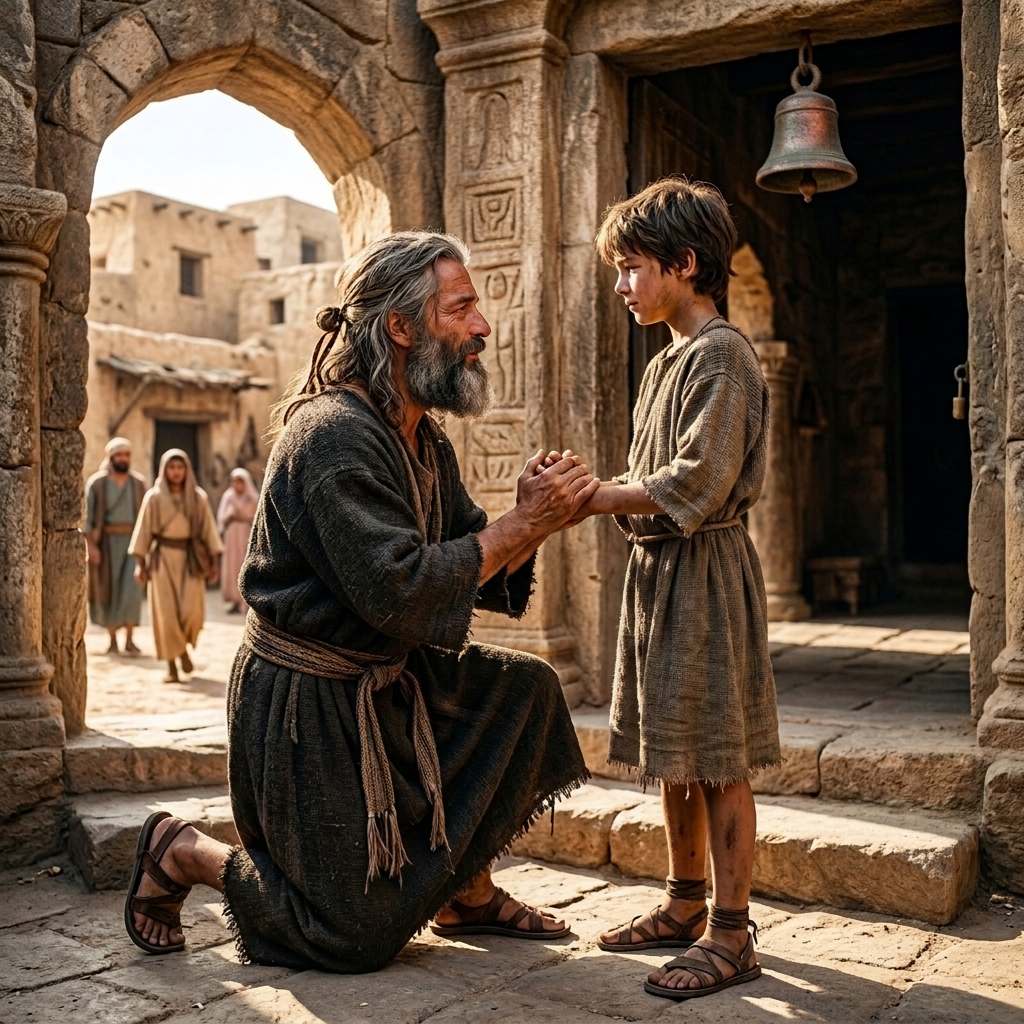
The timeline given — three days (verses 46–50) — likely breaks down as a day travelling out from Jerusalem, a day travelling back, and a day spent searching for Jesus once they realized he was missing.
It’s worth asking how a twelve-year-old ended up sitting among religious teachers in the temple at all. Under Jewish law, a boy became a man at age twelve. During Passover season, it was customary for the Sanhedrin to meet publicly in the temple courts, discussing religious and theological questions in front of anyone who wished to listen.
When Mary and Joseph finally found him, Jesus’s response carries real weight: “Didn’t you know that I must be in my Father’s house?” These are the first recorded words of Jesus in Scripture. At twelve, a son was expected to begin stepping into his father’s trade — a fisherman’s son would become a fisherman, a carpenter’s son would become a carpenter. So it was entirely natural, in Jesus’s mind, that he would go to his Father’s workplace — the temple — to begin taking up his Father’s business.
It raises an intriguing question worth sitting with: did Jesus already understand, even at twelve, that Joseph was only his adoptive father? And had he and Mary ever discussed that reality together?
Growing in Obedience
The chapter closes simply (verses 51–52): Jesus returned home with Mary and Joseph and remained obedient to them until the time came for his public ministry to begin.
The Bigger Picture
Luke chapter 2 is often treated as a sweet, familiar Christmas story — but look closely, and it’s really a picture of God working quietly through ordinary, unlikely, and even disreputable people to bring about the most important event in human history. A pagan emperor unknowingly fulfils prophecy. Disrespected shepherds become the first evangelists. A poor couple offers the sacrifice of the poor. A boy who isn’t even a teenager yet already understands his purpose.
That’s the pattern running through all of Luke’s Gospel: God doesn’t need powerful, polished, or credible people to accomplish his purposes. He simply needs people willing to show up — whether that’s an emperor signing a decree, shepherds running through the night, or a mother quietly treasuring things in her heart.
As you study Luke 2, consider journaling about the moments in this chapter that challenge your assumptions about how God works — through unlikely people, ordinary circumstances, and quiet obedience rather than spectacle.